


This post may contain affiliate links. By browsing this website, you agree to our disclaimer, privacy policy, and terms of use.
Did you know that nail polish may be one of the most toxic items in your home? Yikes. It’s no wonder you are in search of the best non-toxic nail polish brands!
Suppose you’ve ever opened a bottle of nail polish and felt that unmistakable chemical hit, you’re not imagining things.
Traditional nail polish is one of the most chemically intensive personal care products many of us use — and it doesn’t just stay on our nails.
Every manicure releases volatile organic compounds (VOCs) into the air we breathe, washes chemical residues down our drains, and contributes to environmental contamination long after the polish has dried.
Over time, repeated exposure — especially in poorly ventilated spaces — can add up. It’s no surprise so many people go looking for “non-toxic” nail polish. But here’s the truth most beauty guides don’t tell you:
There is no such thing as completely non-toxic nail polish.
At least not in the long-wear, solvent-based formulas most of us are familiar with.
That doesn’t mean safer options don’t exist — they absolutely do — but it does mean we need to be honest about what those labels actually mean.
**Many nail polishes are marketed as “10-free,” “21-free,” or “plant-based,” but still rely on solvent systems that produce VOC exposure similar to conventional lacquer. While these formulas may remove certain flagged ingredients, they do not meaningfully reduce inhalation exposure — which is why they are not included in this guide.
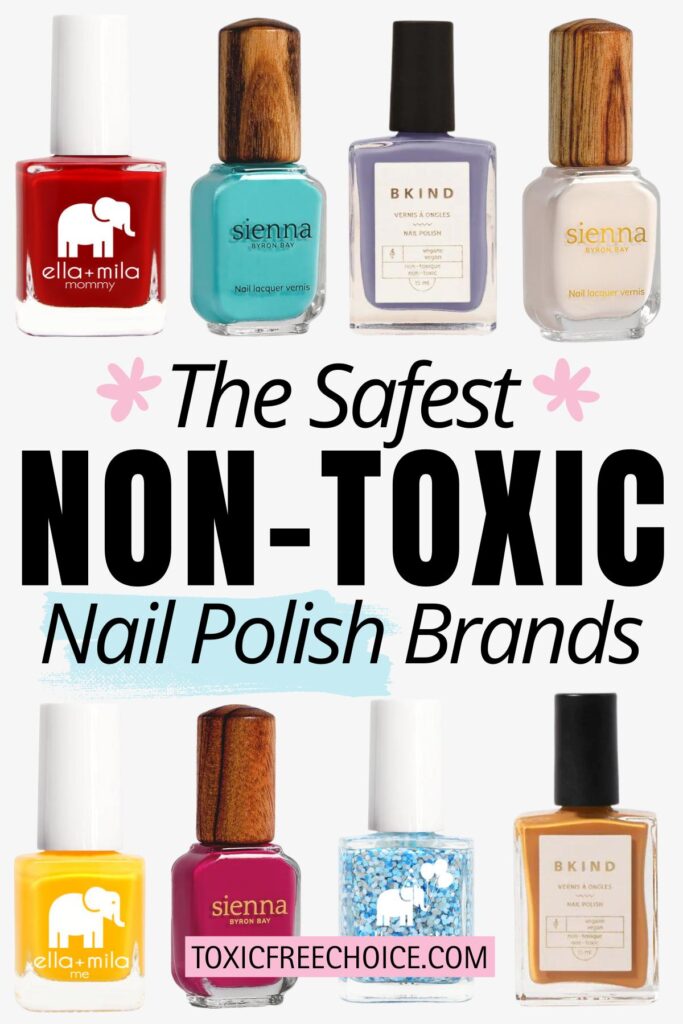
Why “Non-Toxic” Nail Polish Is a Misleading Term
Unlike food or drugs, cosmetics are not required to prove safety before hitting the market, and there is no regulatory definition for terms like non-toxic, clean, or free-from. Labels such as “10-free,” “21-free,” or “plant-based” are brand-defined marketing claims, not guarantees of zero risk.
Most modern “clean” nail polishes still rely on:
- Solvents for smooth application and durability
- Film-forming polymers for wear time
- FDA-approved color additives for pigmentation
These ingredients may be less harmful than older formulations, but they are not chemically inert — especially when inhaled regularly.
So when we talk about safer nail polish at Toxic Free Choice, we’re not chasing perfection. We’re focusing on meaningful risk reduction.
What This Guide Actually Does (and Doesn’t) Claim
This is not a list of “toxin-free” miracle products — because those don’t exist in this category.
Instead, this guide:
- Breaks down which nail polish ingredients matter most
- Explains the difference between water-based vs. solvent-based formulas
- Ranks brands by relative toxicity and exposure, not marketing buzzwords
- Highlights the lowest-exposure options available today
Some options on this list significantly reduce inhalation and endocrine-disrupting risks. Others are simply cleaner than conventional salon polish — and we’ll be clear about that distinction.
How We Ranked These Nail Polish Brands
For this article, we grouped nail polishes into three clear categories:
- Lowest-Exposure Options
Water-based formulas with minimal VOCs and easy removal - Lower-Toxicity Solvent-Based Polishes
Free from the most concerning chemicals but still solvent-based - Clean-Marketed Polishes With Tradeoffs
Better than conventional, but not truly low-tox
Each brand is evaluated based on ingredient disclosure, exposure risk, and transparency, not how high the “free-from” number sounds.
One Important Thing Before We Start
If a nail polish:
- lasts a full week,
- has a strong chemical odor, or
- requires acetone to remove,
…it isn’t truly non-toxic. It’s simply less toxic than traditional polish.
That’s because there is no such thing as completely non-toxic solvent-based nail polish. Even many “10-free” and “21-free” formulas still rely on volatile solvents, film-formers, and regulated color additives to achieve long wear and shine.
That doesn’t mean these products have no value — for many people, the reduced exposure is a worthwhile tradeoff.
This guide ranks nail polishes by relative toxicity and exposure, not perfection, so you can make informed choices based on what matters most to you.
Lowest-Exposure Nail Polish Option
(Closest to Truly Non-Toxic)
These formulas significantly reduce chemical exposure by avoiding traditional solvent systems. They are typically water-based, low-odor, and remove without acetone — making them the lowest-risk option available for at-home manicures.
Tradeoff: shorter wear time and fewer finish options.
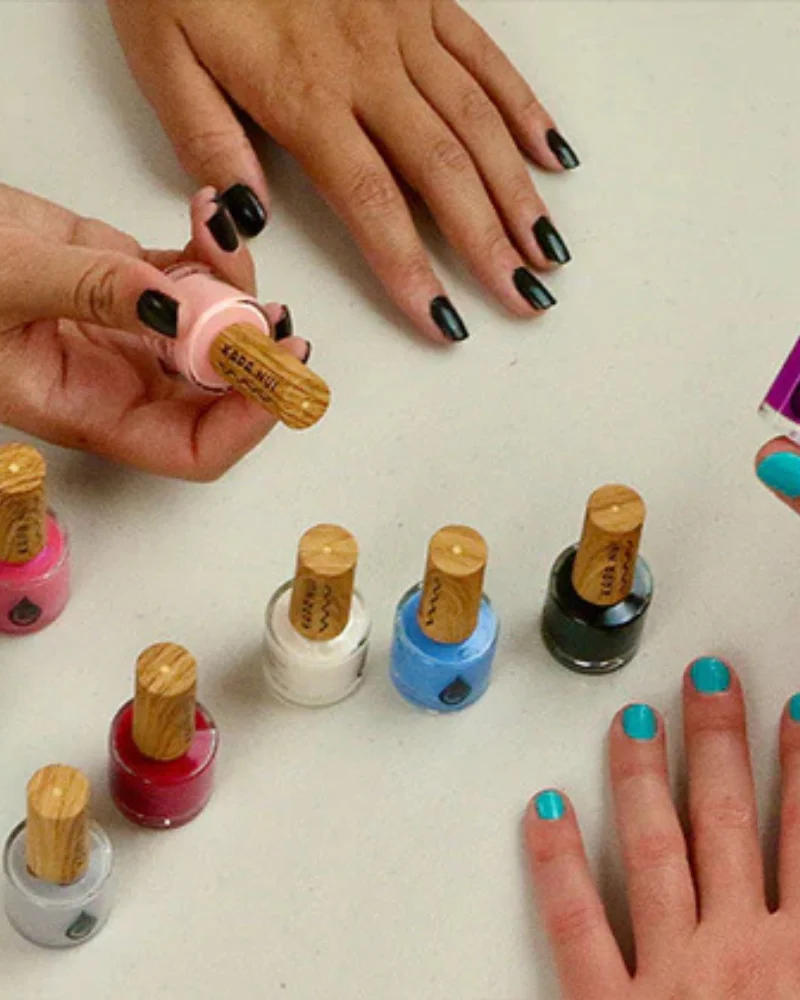
Best for: People seeking minimal VOC exposure, water-based formula, and truly low chemical load
Kapa Nui’s polish is a water-based formula made mostly of water and an acrylates copolymer, with mineral pigments for color. T
his means it doesn’t rely on traditional solvent chemistry (the main source of strong odors and VOC exposure in regular polishes), and it is generally considered one of the least hazardous nail polish options available.
Inspired by Hawaii’s commitment to environmental preservation and clean beauty, this odorless, eco-friendly polish is formulated with just three toxin-free ingredients and is virtually fume-free.
Kapa Nui’s Nail Care System, designed by medical professionals, promotes nail health and removes easily with soap and water, eliminating the need for chemical removers.
Vegan, cruelty-free, and planet-safe, Kapa Nui is dedicated to ocean conservation while providing professional-quality nail polish.
Price
$11.00
EXPOSURE NOTES
Water-based, low-VOC formula that avoids traditional solvent fumes; uses regulated mineral pigments for color.
location/shipping
Made in Hawaii by medical professionals, ships to the US, Canada, Netherlands, Norway, and Belgium.
Lower-Toxicity Solvent-Based Nail Polishes
(Cleaner Than Conventional, With Tradeoffs)
These brands avoid the most concerning nail polish chemicals — including formaldehyde, toluene, DBP, and often TPHP — but still rely on solvents and film-forming agents for durability and color payoff.
Tradeoff: reduced toxicity, not zero exposure.
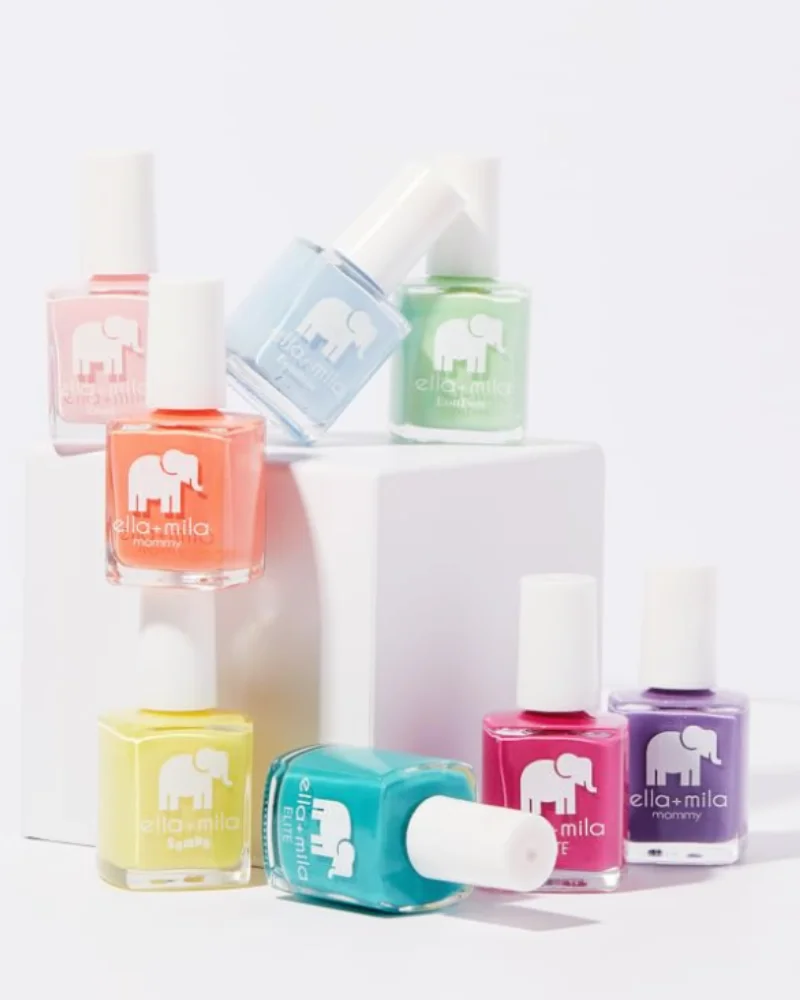
Ella + Mila is a well-known clean beauty nail brand focused on removing the most concerning chemicals commonly found in conventional nail polish, while still delivering strong color payoff and wear time.
Their polishes are 17-free, vegan, and cruelty-free, avoiding ingredients like formaldehyde, toluene, DBP, and camphor. The brand is especially popular with families and those transitioning away from traditional salon polish who still want a familiar lacquer experience.
Ella + Mila formulas are designed for long-lasting wear and quick drying, and many shades are enriched with added conditioners such as vitamins A and E.
The brand frequently releases new collections, offering a wide range of modern, high-shine colors.
Price
$10.50
exposure notes:
Solvent-based polish that avoids the most concerning nail chemicals but still produces VOCs; best used with good ventilation.
location/shipping
Made in the USA, ships to the US and Canada.
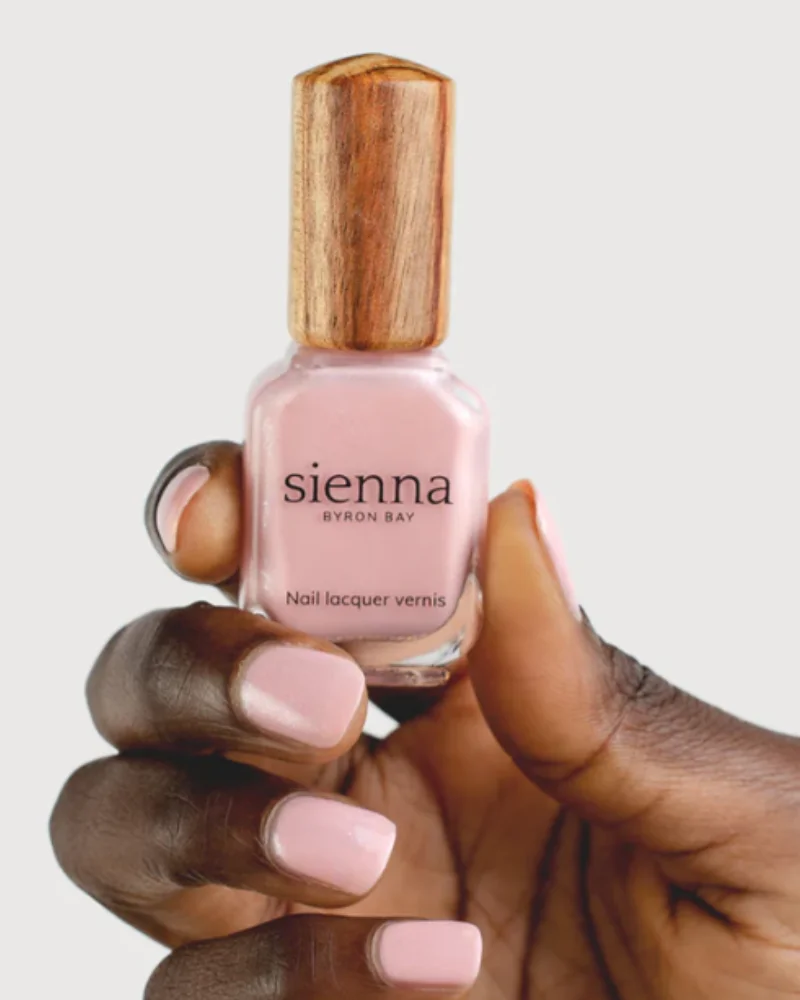
Sienna Byron Bay is an eco-luxe nail care brand known for combining performance-driven polish with a strong sustainability ethos.
Their formulas are plant-based in part, using bio-derived ingredients sourced from sugarcane, cassava, cotton, and corn, while still delivering long-lasting wear and a high-shine finish. Many shades are infused with botanical ingredients like Kakadu plum and Australian tea tree oil.
Sienna Byron Bay is also notable for what it intentionally excludes. Their polish is formulated without nano-particles and benzophenone-1, and the brand is transparent about ingredient sourcing and manufacturing practices.
Beyond formulation, Sienna Byron Bay stands out for its environmental commitments, including carbon-neutral shipping, recyclable packaging, and an in-house recycling program. All products are vegan and cruelty-free.
Price
$29.00
Exposure notes:
Solvent-based, lower-toxicity polish that avoids several high-concern additives but still produces VOCs.
location/shipping
Made in Australia, ships to the US and select international countries.
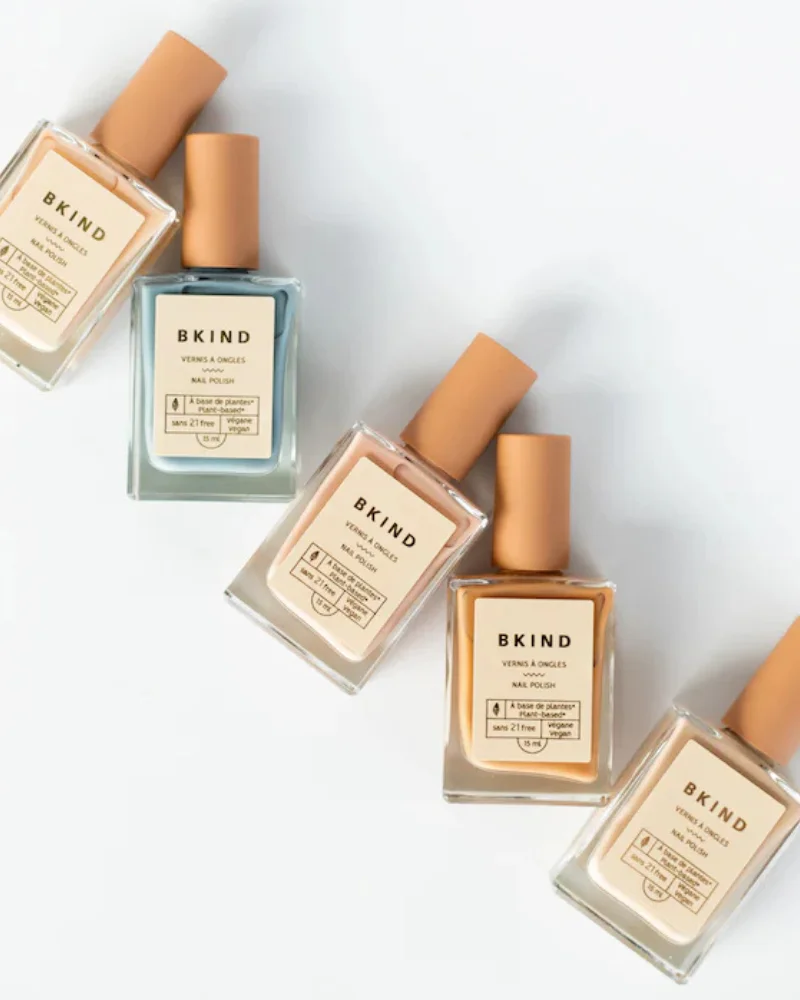
BKIND is a minimalist beauty brand focused on reducing unnecessary additives while still delivering a familiar, long-wear nail polish experience.
Their nail polishes are marketed as 21-free, vegan, and partially plant-based, with a formulation that includes bamboo extract and vitamin E. The brand prioritizes ingredient transparency and positions its polish as a cleaner alternative to conventional salon formulas without sacrificing coverage or durability.
BKIND’s polish performs well for a solvent-based option, with reported wear times comparable to traditional lacquer, making it a good choice for those who want longer wear while avoiding several high-concern nail polish chemicals.
Price
$10.49
exposure notes
Solvent-based, lower-toxicity polish that still produces VOCs; uses regulated mineral pigments.
location/shipping
United States, ships to the US, Ireland, and Hong Kong SAR.
💬 Frequently Asked Questions About Non-Toxic & Lower-Toxicity Nail Polish
No. There is currently no nail polish that is completely non-toxic, especially among long-wear, solvent-based formulas.
Some options are lower-toxicity or lower-exposure, but all involve tradeoffs between durability, ingredients, and chemical exposure.
Traditional nail polish toxicity comes primarily from solvents and fumes, not just individual ingredients.
Many formulas release volatile organic compounds (VOCs) during application and drying, which can be inhaled in enclosed spaces.
Certain ingredients, such as formaldehyde, toluene, DBP, and TPHP, are considered of greater concern.
Sometimes — but not always. “Free-from” labels indicate that a brand avoids a specific list of ingredients, but there is no universal standard for what those numbers mean.
Many “10-free” or “21-free” polishes still rely on solvent systems that produce VOC exposure similar to conventional lacquer.
Water-based nail polish is generally the lowest-exposure option. These formulas avoid traditional solvents, produce little to no odor, and reduce inhalation exposure.
The tradeoff is shorter wear time and fewer finish options.
Yes. Even cleaner, solvent-based nail polishes still release chemical fumes during application and drying. While they may avoid certain high-concern ingredients, they do not eliminate VOC exposure.
Water-based nail polishes are generally considered the lowest-exposure option during pregnancy.
Solvent-based polishes — even “clean” ones — still produce fumes, which is why many healthcare providers recommend minimizing use, improving ventilation, or avoiding nail polish altogether during pregnancy.
Always consult your healthcare provider.
Not necessarily. “Breathable” typically refers to the moisture or oxygen permeability of the film on the nail, not reduced chemical exposure.
Breathable nail polishes may still be solvent-based and produce VOC fumes.
No. While plant-derived ingredients may replace some synthetic components, most nail polishes still require solvents and polymers to function.
Botanical extracts are often added for conditioning, not as structural replacements for chemical film-formers.
This guide only includes brands that offer meaningful exposure reduction, not just ingredient marketing.
Many nail polishes are marketed as “clean” but function similarly to conventional lacquer in terms of fumes and solvents, which is why they are not included here.
Choosing Nail Polish With Clarity, Not Fear!
Nail polish doesn’t need to be an all-or-nothing decision. There is no such thing as a perfectly non-toxic nail polish — especially when durability, shine, and long wear are involved.
But there is a meaningful difference between products that simply market ingredient avoidance and those that genuinely reduce chemical exposure.
This guide was created to help you understand that difference. By focusing on exposure pathways, formula structure, and ingredient transparency, you can choose options that align with your health priorities without relying on vague labels or inflated claims.
For some, that may mean opting for a water-based polish with minimal fumes. For others, it may mean choosing a lower-toxicity solvent-based option and using it less frequently, with better ventilation.
The goal isn’t perfection — it’s informed choice. When you understand what’s actually in your nail polish and how it behaves in real-world use, you’re no longer dependent on marketing language to decide what’s “safe.”
You’re equipped to make decisions based on evidence, context, and your own tolerance for tradeoffs. And that’s exactly where healthier choices begin.
More Guides To Upgrade Your Beauty Routine!
- 💅🏼 Non-Toxic Nail Polish Remover → An evidence-based guide to safer nail polish removers, including acetone vs. non-acetone formulas, fragrance concerns, and common solvent red flags.
- 👄 Non-Toxic & Organic Lip Balm → A safety-focused breakdown of lip balms made without petroleum byproducts, PFAS, synthetic flavoring, or endocrine-disrupting preservatives.
- 💄 Non-Toxic Makeup → A research-backed guide to choosing makeup without PFAS, heavy metal contamination, or hormone-disrupting preservatives—plus how to see past “clean beauty” claims.
- 🧴 Non-Toxic Skincare → An ingredient-driven breakdown of safer skincare ingredients, common toxic red flags, and how to build a hormone-safe routine.
- 🩷 Non-Toxic Beauty Swaps → A practical, safety-first guide to prioritizing high-impact beauty swaps based on frequency of use, skin exposure, and ingredient concern.
📌 Save This Pin For Later
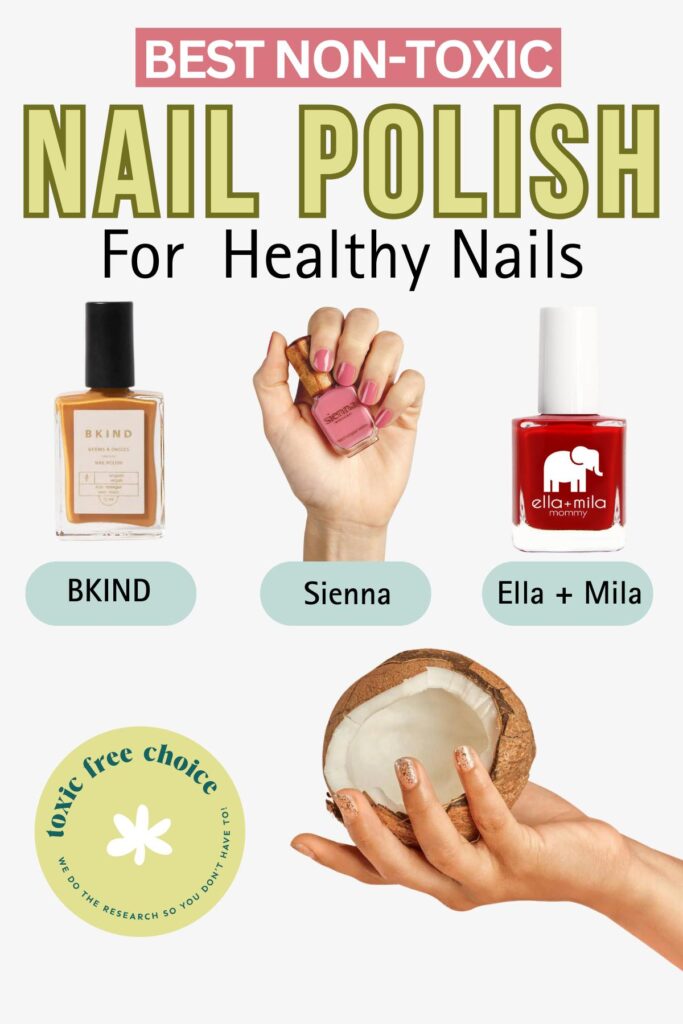
Looking for safer nail polish in 2026? This guide breaks down which ingredients actually matter, how “10-free” and “clean” labels fall short, and which brands meet stricter safety standards—so you can paint your nails without unnecessary chemical exposure.




Jenna, thank you! Which one out of these brands truly lasts the longest? I’ve used only one brand from this list but the formula no longer works on me and chips super fast.
Hi Liz! In my experience, Jin Soon and Sundays held up best. Which one didn’t work out for you? Would be helpful to let others know who are reading this 🙂 I had a bit of chipping from Ella & Mila but I was also renovating the house so the odds were against any nail polish that day haha.
Hi, I love the list for I haven’t painted my nails in forever. I have a question though, I was able to scan one of the polishes by Nails, Inc. and it does list 21 other ingredients risk free, but 1 as high risk Octocrylene for its potential endocrine- disrupting properties, also it may break down over time into Benzophenone, which is a carcinogenic compound reference:( Yuka app
So what are your thoughts, is this truly a toxic free polish?
My nails are painted again but with thoughts of concern again.
Thanks
Melanie P
Hi Melanie — thank you so much for your thoughtful comment and for taking the time to dig into those ingredients. You’re absolutely right to raise concerns about Octocrylene — it’s been flagged for potential endocrine disruption, and its breakdown into benzophenone is something we take seriously too.
The truth is, no nail polish brand is completely risk-free. Even the best “non-toxic” options tend to have at least one ingredient we’d rather avoid — which is why we’ve included a “look out for” note under each brand in the guide, pointing out the ingredients we think deserve extra caution.
We featured Nails Inc. because they’ve removed many of the worst ingredients, but your feedback is a great reminder that “non-toxic” is always on a spectrum. We’ll revisit their current formula and consider an update in our next review round.
In the meantime, if you’re looking for even stricter formulations, brands like Kapa Nui, Sienna Byron Bay, and Habit Cosmetics from our list tend to have simpler, more transparent ingredient profiles.
Thanks again for being part of the conversation!
Odd question. Is there any nail polish with health supplements? Or fungus treatment supplements?
Hi there! Great question. While there isn’t a true “nail polish with supplements” that can actually strengthen nails from the inside out (since polish sits on the nail surface), there are some non-toxic nail polishes that add nourishing ingredients like biotin, vitamin E, or keratin to help improve nail appearance and resilience.
For fungus treatment, most medicated options are separate from nail polish (usually serums or prescription treatments). If nail fungus is a concern, I’d recommend using a doctor-approved antifungal product first, and then once it’s cleared, switching to a safer non-toxic polish brand to maintain nail health.
Hello, I was looking at your first choice today (Habit) and found on their website that they are only 10 free and that they use alcohols and lake colorants and titanium dioxide and ultramarines. Did they change something since this article was written?
Thanks for checking the ingredient list so closely — that’s exactly why the article was recently updated.
Habit is no longer included in this guide. In the rewrite, we shifted away from ranking brands based on “free-from” claims and instead focused on which formulas actually reduce chemical exposure in real-world use. While Habit avoids certain flagged ingredients, it still relies on solvents and regulated colorants, which don’t meaningfully reduce inhalation exposure compared to water-based options.
For that reason, we chose not to include it in the current version of the article.
Appreciate you taking the time to dig into the ingredients — that level of scrutiny is exactly what this update was designed to support.