This post may contain affiliate links. By browsing this website, you agree to our disclaimer, privacy policy, and terms of use.
You’ve probably heard of PFAS—sometimes called “forever chemicals”—but what are they really, and why are they everywhere?
For decades, PFAS have been used in non-stick cookware, waterproof clothing, food packaging, and even stain-resistant carpets. These synthetic chemicals are incredibly durable—which is exactly what makes them so dangerous.
Once PFAS enter our bodies or the environment, they don’t break down easily. In fact, they can linger in the bloodstream for years.
PFAS exposure has been linked to serious health problems, including cancer, hormone disruption, fertility issues, weakened immunity, and developmental delays in children.
And because they’re found in everything from tap water to dust, avoiding them isn’t as simple as switching out a single product.
This guide takes a deep dive into what PFAS are, how they get into our homes and bodies, and—most importantly—what you can do to reduce your risk.
From safer cookware to PFAS-free water filters, we break it all down with practical, research-backed solutions.
PFAS Are Already in Your Home — Here’s What You Need to Know
According to the CDC, 97% of Americans have PFAS in their blood. Let that sink in. These chemicals aren’t some far-off danger—they’re already part of our daily lives.
You’ll find them in your kitchen pans, bathroom products, your kids’ bedding—even in items labeled “green,” “non-toxic,” or “PFOA-free.”
The problem? There are over 14,000 types of PFAS, and new ones are being developed faster than regulators can keep up. It’s a toxic game of whack-a-mole—and most of us have no idea we’re playing.
But here’s the good news: you don’t need a science degree to start protecting your family.
With a little guidance, you can learn what to avoid, what to trust, and which steps actually make a difference.
This guide skips the scare tactics and focuses on real solutions backed by science—so you can make smarter choices with confidence.
🧪 What Are PFAS (and Why You Should Care)
PFAS stands for per- and polyfluoroalkyl substances, a large class of manmade chemicals that have been in use since the 1940s.
Their unique chemistry makes them resistant to water, oil, heat, and stains—which is why they’re used in everything from non-stick pans to stain-proof carpets and waterproof jackets.
The problem? That same resistance means they don’t break down easily. Once they enter the environment or your body, they stick around.
⚠️ The Chemistry of Concern
PFAS contain a carbon-fluorine bond—one of the strongest in all organic chemistry.
This makes them incredibly hard to destroy and helps them accumulate over time in the environment and in human tissue.
Once PFAS enter your bloodstream or the soil beneath your home, they don’t just disappear. They persist for decades, accumulating in blood, organs, and ecosystems.
🚨 A Public Health Threat Hiding in Plain Sight
One of the first consumer uses of PFAS was in DuPont’s non-stick Teflon pans. The slick coating seemed revolutionary—until studies revealed its toxic legacy. But Teflon was just the beginning.
Today, PFAS are found in pizza boxes, dental floss, waterproof mascara, food packaging, and even Arctic polar bears. The reach of these chemicals is now global, and the health concerns are just as far-reaching.
🧬 New Names, Same Old Risks
Once regulators began restricting PFOA and PFOS—two of the most studied and harmful PFAS chemicals—manufacturers didn’t stop using PFAS.
They simply replaced them with slightly altered versions like GenX and PFBS. These newer PFAS are often marketed as “safer alternatives,” but research shows they pose many of the same health risks.
It’s a toxic game of whack-a-mole: ban one, and another pops up. There are now over 14,000 known PFAS compounds, with more being developed all the time. And without strong oversight, these chemicals continue to slip into everyday products.
💬 It’s like trying to drain a bathtub while the tap is still running. Until the source is shut off, the problem only grows.
🧠 How PFAS Affect Your Body and Brain
🛡️ Your Immune System Takes the First Hit
The U.S. National Toxicology Program classifies PFOA and PFOS as presumed immune hazards to humans.
What that looks like in real life:
- Reduced Vaccine Effectiveness: Kids with higher PFAS levels show weaker antibody responses to routine vaccines like tetanus and measles
- More Frequent Infections: Including bronchitis, pneumonia, and respiratory illnesses
- Longer Recovery Times: PFAS weaken your body’s natural defenses
The European Food Safety Authority considers immune suppression so critical that it bases its drinking water standards on this effect alone.
🤰 Fertility and Reproductive Health
PFAS exposure affects both women and men:
- Women with high PFAS levels face up to 40% reduced fertility
- Disrupts menstrual cycles and can trigger earlier menopause
- Increases the risk of pregnancy complications like preeclampsia
- Lowers birth weights in babies
- Prenatal exposure leads to lower sperm quality and altered hormone levels in adult males
👶 A mother’s PFAS exposure during pregnancy can impact her child’s fertility decades later.
🧬 The Cancer Connection
The International Agency for Research on Cancer (IARC) classifies PFOA as possibly carcinogenic to humans.
The landmark C8 Science Panel, which studied 69,000 people, found “probable links” between PFAS exposure and:
- Kidney cancer
- Testicular cancer
- Thyroid disease
- Ulcerative colitis
PFAS accumulate primarily in the liver, kidneys, and blood—making these organs the most vulnerable.
🔄 Metabolic & Hormonal Disruption
PFAS interfere with metabolic and endocrine systems, especially in children:
- Elevated Cholesterol: Harvard analysis of 29 studies found consistent links to higher LDL and triglycerides
- Non-Alcoholic Fatty Liver Disease: PFAS stress liver cells, triggering inflammation
- Thyroid Dysfunction: Can result in hypothyroidism or hormonal imbalance
- Weight Gain & Obesity: Linked to early-life PFAS exposure
🧒The Developing Brain at Risk
PFAS exposure begins before birth and can affect neurological development:
- Reduced birth weight
- Earlier puberty in girls
- Potential delays in brain development and cognition
- Increased behavioral challenges
⚠️ These effects occur at PFAS levels considered “normal” in the general population. There is no known safe threshold.
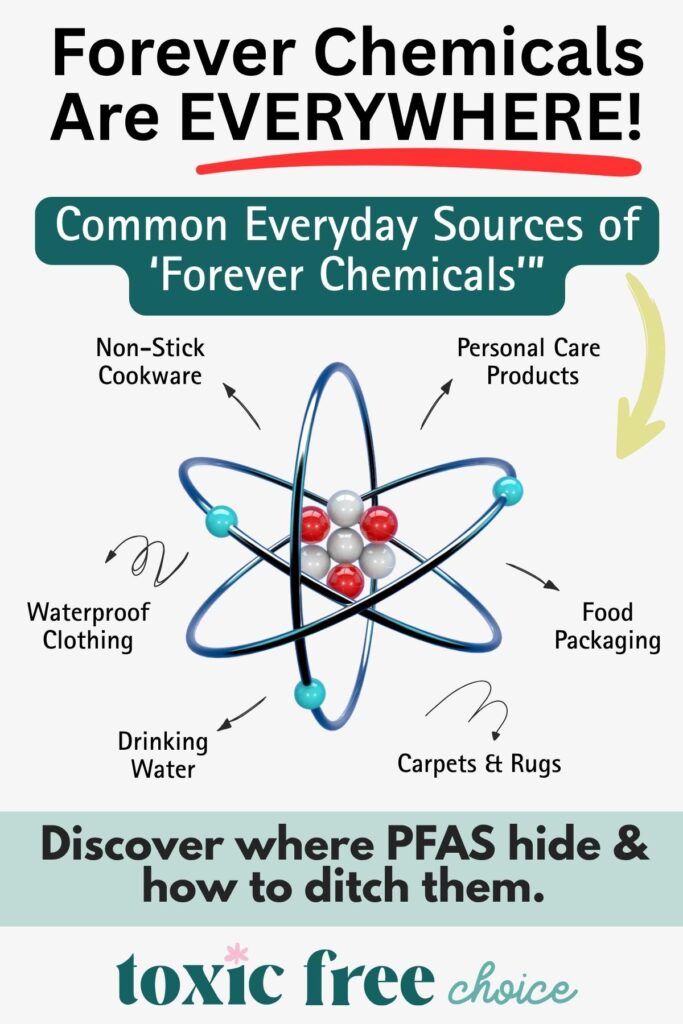
🏠 Where PFAS Hide in Your Home
🔪 The Kitchen
Non-stick cookware is the obvious culprit. Consumer Reports tested popular “PFOA-free” pans and found Swiss Diamond cookware still contained 639-703 parts per billion of combined PFAS.
That “PFOA-free” label? Meaningless when they just swap in other PFAS.
The Ecology Center’s testing revealed that 79% of non-stick cooking pans contain PTFE (another PFAS). When overheated above 500°F (which happens faster than you think), these coatings release PFAS directly into your food and air.
But cookware is just the start:
- Microwave Popcorn Bags: Testing found 37 products exceeding 20 ppm PFAS, with 22 products above 100 ppm
- Fast Food Wrappers: Consumer Reports detected PFAS in McDonald’s burger wrappers, Burger King french fry bags, Chick-fil-A containers, and Cava salad bowls
- Pizza Boxes: That grease-resistant coating? PFAS.
- Parchment Paper & Baking Sheets: If it’s non-stick or grease-proof, suspect PFAS
The heat from cooking accelerates PFAS migration into your food. Fresh ingredients cooked in PFAS-free cookware beat any “convenient” option.
🛁 The Bathroom
Brace yourself for this one. Oral-B Glide Pro-Health dental floss tested at 248,900 ppm PFAS, nearly 25% of its total weight. You’re literally sliding concentrated forever chemicals between your teeth.
That’s not even the worst part. University of Notre Dame researchers tested 231 cosmetics and found PFAS in over half, with the highest concentrations in:
- Waterproof mascaras
- Long-wear liquid lipsticks
- Foundation marketed as “long-lasting” or “wear-resistant”
The Environmental Working Group’s database identifies 200 products from 28 major brands containing 13 different PFAS.
Any product promising to be waterproof, long-wearing, or smudge-proof likely contains these chemicals.
For a cleaner beauty routine, browse our best non-toxic makeup brands on our sister site Sustainably Kind Living, all tested, ingredient-transparent, and free from PFAS and other hormone disruptors.
🪑 Furniture & Flooring
The CDC identifies carpet as the #1 PFAS exposure pathway for infants and toddlers.
Here’s why that’s really scary:
Stainmaster carpet, introduced in 1986, spread over 400 million square yards of PFAS-treated carpet into American homes by 1990. Current estimates: 11 billion square yards sold annually.
The National Health and Nutrition Examination Survey found people with low-pile carpets had significantly higher blood levels of PFHxS and MeFOSAA.
A Canadian family study documented exceptionally high PFAS blood levels linked to routine Scotchgard carpet treatments.
Our kids crawl on these carpets. They put their hands in their mouths. They breathe in PFAS-laden dust stirred up by everyday activity.
And it’s not just the carpet that’s the problem. Furniture with stain-resistant treatments adds another layer of exposure. That “performance fabric” on your couch? PFAS. The stain-guard treatment on your dining chairs? More PFAS.
If you’re ready to make a swap, explore our favorite non-toxic rugs that are safe for crawling kids, pets, and barefoot living.
👕 Your Closet
Every piece of clothing labeled water-resistant, stain-resistant, or wrinkle-free likely contains PFAS:
- Rain jackets and waterproof gear
- Hiking boots and outdoor clothing
- School uniforms with stain-resistant treatments
- Athletic wear with moisture-wicking properties
These sustainable jackets and PFAS-free coats are stylish, high-performing, and safe for long-term wear.
California and New York banned PFAS in textiles effective January 1, 2025, forcing major changes.
Some brands like Patagonia eliminated PFAS from all products by Spring 2025. But many major outdoor brands like The North Face and Columbia are still transitioning.
👶 The Nursery
This is where it gets heartbreaking.
Ecology Center testing found PFAS in 4 of 19 car seats tested, including matching strollers. Products marketed as “easy to clean” or “stain-resistant” almost always contain PFAS.
Other baby gear with PFAS:
- Waterproof crib mattresses
- Changing pad covers
- Bibs marketed as “stain-proof”
- Play mats with water-resistant surfaces
The good news? Some manufacturers are leading change. For verified PFAS-free sleep options, check out SKL’s guide to the safest organic crib mattresses for babies and toddlers.
🚰 Your Tap Water
Even if you threw out every PFAS-containing product today, your tap water might still be contaminated.
165 million Americans live in communities with PFAS-contaminated drinking water.
USGS national testing shows 45% of tap water samples contain at least one type of PFAS, with similar rates in private wells and public water systems.
The highest concentrations cluster around:
- Military bases and airports (firefighting foam)
- Chemical manufacturing facilities
- Landfills and wastewater treatment plants
- Agricultural areas using contaminated biosolids
PFAS in water are particularly dangerous because you drink it, cook with it, and bathe in it daily. It’s the exposure route you can’t avoid without intervention.
Curious about whole-house filtration? We break down the pros, cons, and top-rated models in this expert guide to whole-house water filters.
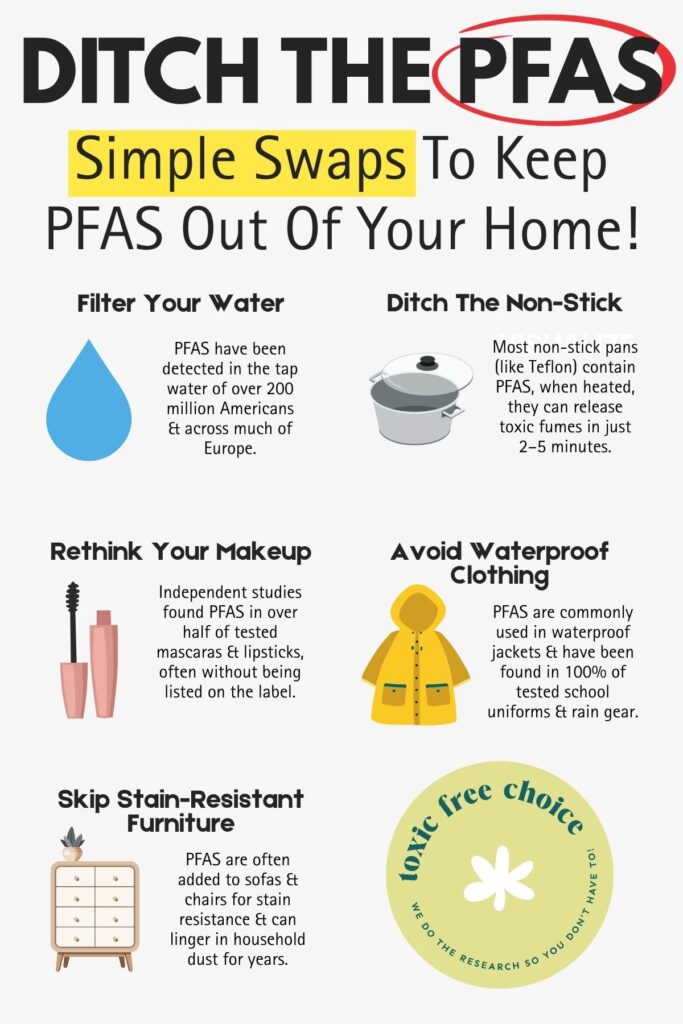
💡 How to Avoid PFAS: High-Impact Swaps
Feeling overwhelmed? Don’t panic. You can dramatically reduce PFAS exposure by focusing on the products you use every day.
These high-impact swaps are the best place to start:
💧 Filter Your Water
Water is one of the biggest daily sources of PFAS exposure. Filtering it is your best first step.
- Best Option: Reverse osmosis (RO) systems
- Look For: NSF/ANSI 58 certification
- Backup Option: Certified carbon filters (NSF/ANSI 53)
Trusted PFAS-free water filter brands:
- AquaTru – Countertop RO system, third-party tested
- Clearly Filtered – Under-sink & pitcher options
- Kind Water Systems – Whole-house filtration
- iSpring – High-capacity RO for families
- Alexapure – Gravity-fed, PFAS-tested
💡 RO systems are an investment—but they tackle the most consistent exposure: your drinking water.
🍳 Ditch the Non-Stick
Most non-stick cookware contains PFAS—even “PFOA-free” pans. Swap them out for safer materials like:
- Cast iron (naturally non-stick)
- Stainless steel (durable, PFAS-free)
- Carbon steel (lightweight, high performance)
- 100% ceramic (solid, not coated)
- 360 Cookware (Use code TFC15 for 15% off) – Surgical-grade stainless steel
- Xtrema Cookware (Use code TFC for 15% off) – 100% solid ceramic cookware
- Our Place – Titanium Always Pan (PFAS-free ceramic)
💄 Rethink Your Makeup
Waterproof and long-wear cosmetics often contain hidden PFAS like PTFE or fluoro compounds. If it promises all-day wear, it might come at the cost of clean ingredients.
Makeup brands we trust:
- Piper Blue – Use code TFC10 for 10% off
- Lauren Brooke Cosmetiques
- River Organics – Use code TFC15 for 15% off
🧺 Choose Safer Textiles
From clothing to furniture, PFAS are commonly used to make fabrics water-, stain-, and wrinkle-resistant.
- Avoid “stain-resistant,” “performance,” or “easy-clean” textiles
- Choose natural materials like organic cotton, hemp, and wool
Trusted textile brands & resources:
- Non-Toxic Rugs for Every Room
- PFAS-Free & Sustainable Fashion Brands
- Non-Toxic Furniture Brands for a Safer Home
🛋️ Look for brands that clearly state PFAS-free materials and back it with third-party testing.
🛒 Shop Smart at the Grocery Store
Food packaging is a major but overlooked source of PFAS exposure. Avoid:
- Microwave popcorn bags
- Grease-resistant wrappers and boxes
- Takeout containers (especially hot or greasy food)
Easy swaps:
- Choose unpackaged produce or bulk items
- Transfer the takeout food out of its packaging immediately
- Bring your own reusable containers when possible
- Look for PFAS-free certified compostables (not just “BPI-certified”)
🛍️ Whole Foods and Sweetgreen are already phasing PFAS out of their food packaging.
📦 Want help swapping out plastic wrap and containers? Check out our non-toxic food storage guide.
How to Read Labels for PFAS
This might surprise you, but as dangerous as PFAS are, they are almost never listed on product labels. Companies aren’t required to disclose them, so you need to become a detective.
🚩 Marketing Terms That Should Raise Red Flags
- Non-stick (except cast iron or stainless steel)
- Stain-resistant or stain-repellent
- Water-resistant or waterproof
- Grease-proof or oil-resistant
- Easy clean or stays clean longer
- Durable water repellent (DWR)
- Performance fabric
🧪 Chemical Names to Avoid
If you’re lucky enough to find an ingredient list, watch for terms like:
- PTFE (polytetrafluoroethylene)
- PFOA (perfluorooctanoic acid)
- PFOS (perfluorooctane sulfonate)
- PFHxS (perfluorohexane sulfonic acid)
- GenX chemicals
- Anything with “fluoro” or “perfluoro” in the name
- Chemical names with long carbon chains and multiple “F” (like C8F17)
🔍 The “PFOA-Free” Deception
This is where companies get sneaky. “PFOA-free” absolutely does not mean PFAS-free.
Swiss Diamond cookware, for instance, was marketed as “PFOA-free” but tested at over 600 ppb for other PFAS. It’s like advertising “cyanide-free” while using arsenic instead.
If a product says “PFOA-free,” ask what they’re using instead. Chances are, it’s just another PFAS that hasn’t been banned yet.
✅ Certifications That Actually Mean Something
Skip vague claims and look for trusted third-party certifications:
- GOTS (Global Organic Textile Standard): Prohibits all PFAS in textiles
- OEKO-TEX MADE IN GREEN: Tests for harmful substances, including PFAS
- GreenScreen Certified: Screens for PFAS and other toxic chemicals
- MADE SAFE: Screens out known PFAS and hundreds of harmful ingredients
If there’s no certification, assume the worst — especially for water-resistant or stain-proof items.
♻️ Can You Detox PFAS from Your Body or Home?
Let’s get this out of the way: no supplement, sauna, or detox tea can remove PFAS from your body.
These chemicals are incredibly persistent and bind tightly to proteins in your blood and organs. Once they’re in, they stick around.
🚫 Why Body Detox Doesn’t Work
- PFAS are designed to resist breakdown in your body and in the environment.
- They bind to albumin in your blood and key enzymes in your liver.
- Worse, they are often reabsorbed rather than excreted during normal circulation.
A few medical approaches show limited promise:
- Blood donation has been shown to modestly reduce PFAS in high-exposure workers.
- Cholestyramine, a prescription drug for cholesterol, may help interrupt reabsorption—but only under a doctor’s supervision.
⚠️ Bottom line: There is no proven, practical way to remove PFAS from your body. Prevention is your best defense.
🧼 What About Detoxing Your Home?
Now here’s where you can make a real difference.
Since you can’t flush PFAS from your system, the key is minimizing new exposure, especially from household sources.
Smart ways to reduce PFAS at home:
- Use a HEPA vacuum to trap PFAS-laden dust.
- Clean with damp cloths instead of dry dusting to prevent particles from spreading.
- Install HEPA air filters with activated carbon in rooms with synthetic materials.
- Increase ventilation when cooking, especially with older non-stick cookware.
High-impact items to remove or replace:
- Old carpeting (especially installed before 2000) treated with stain-repellent sprays.
- Peeling non-stick cookware (even if it says “PFOA-free”).
- Stain-resistant furniture or textiles, unless verified PFAS-free.
🧽 PFAS may be “forever” in the environment—but they don’t have to be forever in your home.
🏛️ What’s the Government Doing About PFAS?
Federal Action: A Slow but Crucial Start
In April 2024, the U.S. Environmental Protection Agency finalized long-awaited drinking water regulations for PFAS.
The new rules set enforceable limits at 4 parts per trillion (ppt) for PFOA and PFOS, and 10 ppt for GenX, PFHxS, and PFNA, five of the most studied and harmful PFAS compounds.
To help communities meet these limits, the federal government allocated $1 billion in funding to upgrade public water systems. It’s a meaningful step, but one that only scratches the surface of PFAS contamination nationwide.
State-Level Bans: A Patchwork of Protection
States like California, Maine, and Washington have led the charge on banning PFAS in consumer products, including textiles, cosmetics, and food packaging.
But state water standards still vary wildly. Some remain thousands of times more lenient than EPA recommendations, leaving many Americans without consistent protection.
Global Momentum: The EU Leads the Way
The European Union is pushing for a near-total ban on 10,000+ PFAS chemicals, with implementation expected between 2026 and 2027.
This sweeping proposal could become the most ambitious PFAS restriction to date and will likely influence global product design and supply chains for years to come.
❓ PFAS FAQs: Quick Answers to Big Questions
PFAS stands for per- and polyfluoroalkyl substances.
These are synthetic chemicals developed in the 1940s that are used in thousands of consumer and industrial products because they resist heat, water, oil, and stains.
You’ll find PFAS in everything from non-stick cookware and waterproof clothing to food packaging and cosmetics.
Their chemical structure includes carbon-fluorine bonds—among the strongest in organic chemistry—which makes them both effective and nearly impossible to break down.
PFAS are known as “forever chemicals” because they don’t break down naturally in the environment or the human body.
They can persist in your bloodstream for years—some for over a decade—accumulating with each additional exposure through water, food, and products.
This long-term buildup is what makes them particularly concerning for human health.
PFAS have been linked to a wide range of health issues, including cancer, fertility problems, liver damage, thyroid disruption, high cholesterol, and weakened immune response.
In children, exposure has been associated with low birth weight, developmental delays, and reduced vaccine effectiveness.
Because they interfere with hormone regulation and accumulate in organs, even small exposures can have lasting effects.
Most products don’t list PFAS directly on the label, and manufacturers aren’t required to disclose them.
Look out for marketing terms like “non-stick,” “stain-resistant,” “water-repellent,” or “grease-proof.” Ingredient lists may include PTFE (Teflon), PFOA, PFOS, or anything with “fluoro” or “perfluoro” in the name.
If a brand doesn’t publish third-party testing or clearly state PFAS-free, assume it may contain them.
Common PFAS sources include non-stick cookware, parchment paper, microwave popcorn bags, stain-resistant furniture and rugs, waterproof makeup, dental floss, and contaminated tap water—especially near military bases, airports, or landfills.
Unless a product is explicitly PFAS-free and tested, there’s a good chance you’re encountering it regularly.
Some can, but not all.
Look for filters certified under NSF/ANSI Standard 53 or 58, which typically include reverse osmosis systems and advanced carbon block filters.
Pitcher-style filters may not be sufficient unless explicitly certified for PFAS. If you’re unsure, ask the manufacturer for lab test results.
Unfortunately, there is no proven way to detox PFAS from your body.
These chemicals bind tightly to blood proteins and liver enzymes and are often reabsorbed rather than expelled.
Some studies show modest reduction from blood donation or medications like cholestyramine, but these aren’t practical for general use. The best strategy is to prevent new exposure.
Regulations are starting to catch up, but most PFAS restrictions won’t fully take effect until 2026 or later.
In the meantime, your best defense is personal action. Swapping out high-risk items like cookware, textiles, and water filters can make a measurable difference in your long-term health.
You don’t need to be perfect—just start with what matters most and build from there.
Looking for more non-toxic living tips? Check out these other amazing articles.
- Non-Toxic Kitchen Utensils
- Non-Toxic Bakeware
- Non-Toxic Throw Blankets
- PFAS-Free Non-Toxic Baking Accessories
- PFAS-Free Sparkling Water
- Safest Raincoats & Rain Boots
- Non-Toxic Water Filter Pitchers
- Non-Toxic Water Filters
- Best Indoor Air Purifiers
Like It? Pin It!
References:
- National Institute of Environmental Health Sciences. (2019). Perfluoroalkyl and polyfluoroalkyl substances (PFAS) [PDF]. U.S. Department of Health and Human Services.
https://www.niehs.nih.gov/sites/default/files/health/materials/perfluoroalkyl_and_polyfluoroalkyl_substances_508.pdf - National Institute of Environmental Health Sciences. (n.d.). Perfluoroalkyl and polyfluoroalkyl substances (PFAS).
https://www.niehs.nih.gov/health/topics/agents/pfc - Alfa Chemistry. (n.d.). Carbon-fluorine bond.
https://fluoropolymers.alfa-chemistry.com/resources/carbon-fluorine-bond.html - Lathrop GPM. (n.d.). EPA’s new lifetime health advisories for PFOA and PFOS rely on health outcome associations rejected by the National Academies of Sciences, Engineering, and Medicine.
https://www.lathropgpm.com/insights/epas-new-lifetime-health-advisories-for-pfoa-and-pfos-rely-on-health-outcome-associations-rejected-by-the-national-academies-of-sciences-engineering-and-medicine/ - Environmental Health News. (2023). Arctic animals show rising levels of toxic PFAS chemicals.
https://www.ehn.org/arctic-animals-show-rising-levels-of-toxic-pfas-chemicals - National Center for Biotechnology Information. (2005). Perfluorinated chemicals: Potential sources, environmental levels, and human exposure. PMC.
https://pmc.ncbi.nlm.nih.gov/articles/PMC11359344/ - National Center for Biotechnology Information. (2021). Health effects of perfluoroalkyl substances. PMC.
https://pmc.ncbi.nlm.nih.gov/articles/PMC7906952/ - University of Rochester Medical Center. (n.d.). ‘Forever chemicals’: Lasting effects of prenatal PFAS exposure shape baby immunity.
https://www.urmc.rochester.edu/news/story/forever-chemicals-lasting-effects-prenatal-pfas-exposure-shapes-baby-immunity - European Food Safety Authority. (2023). PFAS in food: EFSA assesses risks and sets tolerable intake.
https://www.efsa.europa.eu/en/news/pfas-food-efsa-assesses-risks-and-sets-tolerable-intake - Mount Sinai Exposomics. (2023). Study finds exposure to PFAS found in everyday products is linked to significantly reduced fertility.
https://mountsinaiexposomics.org/study-finds-exposure-to-pfas-found-in-everyday-products-is-linked-to-significantly-reduced-fertility/ - California Office of Environmental Health Hazard Assessment. (n.d.). Peer review comments on PFOA and PFOS.
https://oehha.ca.gov/sites/default/files/media/downloads/water/peer/pfoapfospeerreviewcomments.pdf - C8 Science Panel. (n.d.). Probable link evaluation.
http://www.c8sciencepanel.org/prob_link.html - Harvard T.H. Chan School of Public Health. (2018). Exposure to PFAS is associated with increased blood lipids, possible cardiovascular disease.
https://hsph.harvard.edu/news/exposure-to-pfas-associated-with-increased-blood-lipids-possible-cvd-risk/ - National Center for Biotechnology Information. (2004). Toxicology of perfluoroalkyl substances. PMC.
https://pmc.ncbi.nlm.nih.gov/articles/PMC11946724/ - National Academies of Sciences, Engineering, and Medicine. (2023). Public health effects of per- and polyfluoroalkyl substances. National Academies Press.
https://nap.nationalacademies.org/read/26156/chapter/1 - Swiss Diamond. (n.d.). Consumer right to know disclosure.
https://swissdiamond.com/pages/consumer-right-to-know-disclosure - Ecocenter. (n.d.). Undisclosed PFAS coatings are common.
https://www.ecocenter.org/our-work/healthy-stuff-lab/reports/whats-cooking/undisclosed-pfas-coatings-common - Environmental Health News. (2023). PFAS in dental floss.
https://www.ehn.org/pfas-floss - University of Notre Dame. (2023). Use of PFAS in cosmetics widespread, new study finds.
https://news.nd.edu/news/use-of-pfas-in-cosmetics-widespread-new-study-finds/ - Floor Daily. (2017). 25 years of change: Industry veterans look back on the past quarter century.
https://www.floordaily.net/floorfocus/25-years-of-change-industry-veterans-look-back-on-the-past-quarter-century-augsep-2017 - U.S. Environmental Protection Agency. (2021). Multi-industry PFAS study preliminary report [PDF].
https://www.epa.gov/system/files/documents/2021-09/multi-industry-pfas-study_preliminary-2021-report_508_2021.09.08.pdf - United States Geological Survey. (2023). Tap water study detects PFAS ‘forever chemicals’ across the US.
https://www.usgs.gov/media/images/pfas-select-us-tapwater-locations - Consumer Reports. (2023). To reduce PFAS levels in food, cook at home.
https://www.consumerreports.org/food-safety/to-reduce-pfas-levels-in-food-cook-at-home/ - National Center for Biotechnology Information. (2022). PubMed: PFAS research.
https://pubmed.ncbi.nlm.nih.gov/35394514/ - National Center for Biotechnology Information. (2019). Toxicological profile for perfluoroalkyls [Italicized].
https://www.ncbi.nlm.nih.gov/sites/books/NBK584691/ - U.S. Environmental Protection Agency. (n.d.). Per- and polyfluoroalkyl substances (PFAS).
https://www.epa.gov/sdwa/and-polyfluoroalkyl-substances-pfas