This post may contain affiliate links. By browsing this website, you agree to our disclaimer, privacy policy, and terms of use.
Kids wear sandals all summer long—hours of direct skin contact, in heat, sweat, and sun.
While you’re stocking up on non-toxic sunscreen and stainless steel water bottles, their shoes might be the most toxic thing they wear.
Many popular kids’ sandals are made with PVC, EVA foam, or polyurethane—materials often laced with hormone disruptors like phthalates, PFAS, and formaldehyde.
This guide breaks down the real risks, what to look for, and which brands pass our strictest safety standards.
Why Toxic Sandals Are a Bigger Deal Than You Think
Kids wear sandals all summer long—hours of direct skin contact in heat, sweat, and sun.
But while many parents focus on non-toxic sunscreen and stainless steel water bottles, sandals often slip under the radar.
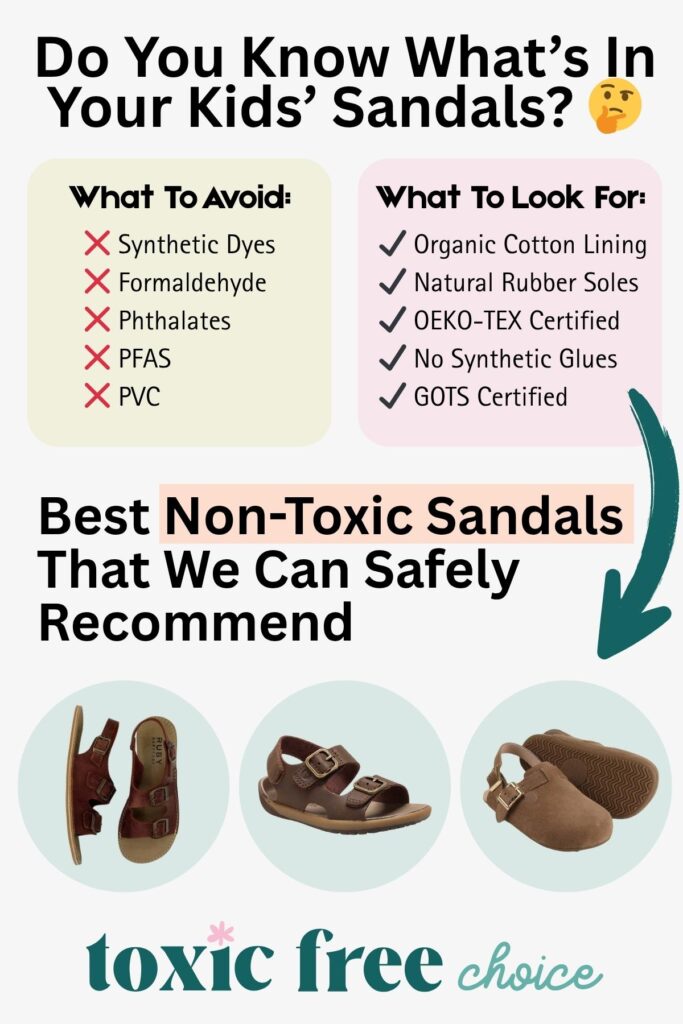
Many popular children’s sandals are made with PVC, polyurethane, and EVA foam—materials frequently laced with hormone-disrupting chemicals like phthalates, PFAS, formaldehyde, and VOCs.
These toxins can absorb straight through the skin, especially in warm, moist conditions.
Children are more vulnerable to these exposures:
- Their skin is more permeable than adults‘
- Their surface area-to-body-weight ratio is higher
- Their organs are still developing
- They often put their hands and objects in their mouths
Yet, in the U.S., children’s footwear is barely regulated. The Consumer Product Safety Commission does not require chemical disclosures for shoes.
Unlike toys, there’s no mandated ingredient list or testing. A sandal and a pacifier may sit side by side on a shelf, but only one is legally required to be safe.
☀️ Related Read: While you’re here, check out our Safest Sunscreens for Babies and Kids and The Most Toxic Sunscreen Brands To Avoid to protect your little ones head to toe.
The Most Common Toxic Materials in Kids’ Sandals
❌ PVC (Polyvinyl Chloride)
Often softened with phthalates, which have been linked to reproductive and developmental harm. PVC also releases dioxins during manufacturing.
❌ EVA Foam (Ethylene-Vinyl Acetate)
Cheap and cushiony, but may contain:
- Formamide: a reproductive toxicant
- Vinyl acetate monomers: known to off-gas in heat
❌ Polyurethane (PU)
Used in “vegan leather” and midsoles; can contain solvents, plasticizers, and is rarely fully disclosed.
❌ PFAS (Per- and polyfluoroalkyl substances)
Found in water-resistant or stain-resistant coatings. These “forever chemicals” bioaccumulate in the body and are linked to hormone disruption, cancer, and immune suppression.
❌ Formaldehyde
Used in adhesives and textile treatments. A known carcinogen and skin irritant.
❌ VOCs (Volatile Organic Compounds)
Including toluene and benzene, which are off-gas from adhesives and foams. Linked to respiratory and neurological issues.
❌ Heavy Metals
Lead, cadmium, and chromium have been found in dyes and decorative elements. These metals exceed international safety limits in some footwear.
❌ Triclosan
Used as an antimicrobial treatment, but disrupts the skin microbiome and contributes to antibiotic resistance.
EVA Case Study: The Most Common “Safe” Material That Isn’t
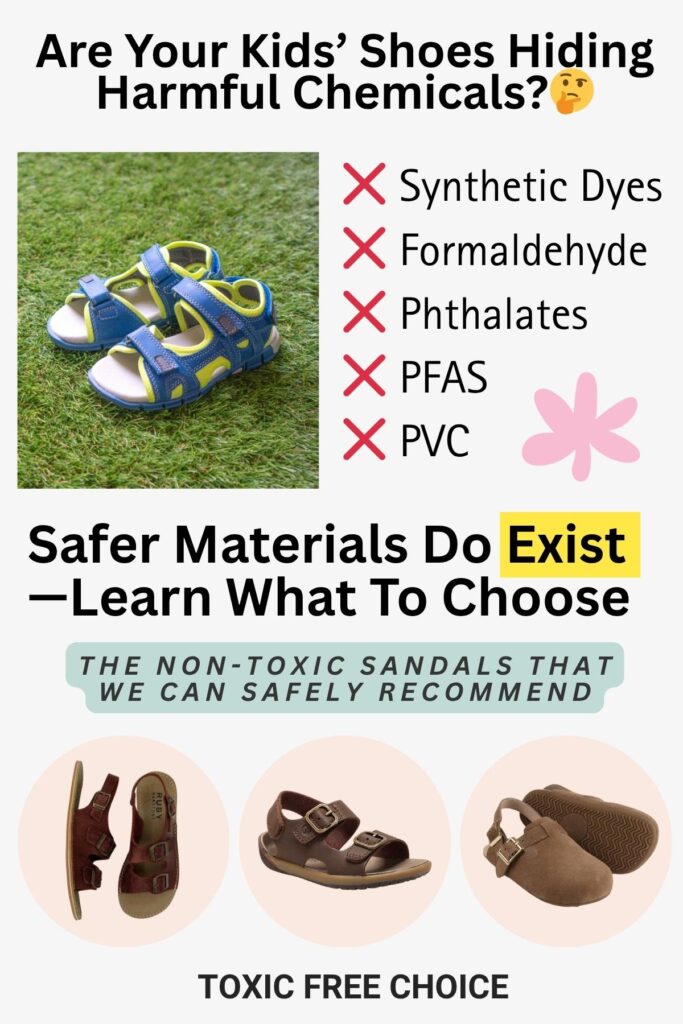
EVA foam is everywhere in kids’ sandals. It’s marketed as lightweight and flexible.
But a 2023 study in Environmental Science & Technology found formamide and vinyl acetate—both toxic compounds—in EVA foam used in children’s shoes.
EVA itself isn’t considered hazardous. The danger comes from the additives used during manufacturing—solvents, plasticizers, catalysts—none of which companies are required to disclose.
In contrast, countries like Denmark and France are pushing to restrict formamide in foam products. In the U.S.? Nothing.
🎒 Related Tip: For more summer safety, don’t miss our Non-Toxic Summer Camp Checklist and Non-Toxic Pool Toys.
Don’t Trust These Labels
Many labels are designed to sound safe without being meaningful:
- “Eco-friendly”: Unregulated. It can still mean plastic.
- “BPA-free”: Doesn’t rule out phthalates or PVC.
- “Vegan leather”: Usually polyurethane or PVC.
- “Non-toxic”: Not legally defined or enforced.
Without third-party testing, these claims are just marketing.
How to Shop for Truly Non-Toxic Kids’ Sandals
1. Start in the Right Places
- Skip big box stores packed with synthetic options
- Look for European brands with stricter regulations
- Support local shoemakers who use natural materials
2. Ask Before You Buy
Contact the company directly:
- What materials are used in each component?
- Are your shoes free from PVC, EVA, polyurethane, and synthetic rubber?
- Do you have third-party test results?
- Where are the shoes manufactured?
Red flag responses: “proprietary blend,” “trade secret,” or no reply.
3. Look for These Certifications
- OEKO-TEX STANDARD 100: Screens for 100+ harmful substances (ensure the full shoe or applicable parts are tested)
- GOTS (Global Organic Textile Standard): For fabric straps or linings made of natural fibers
Certifications are a helpful start, but not a guarantee. Most do not cover the entire shoe or all chemical categories.
4. Safe Materials Checklist
✅ Safe Soles:
- Natural rubber (not synthetic)
- Cork
- Vegetable-tanned leather
- Recycled tire (if well-processed)
✅ Safe Straps:
- Vegetable-tanned leather
- Organic cotton
- Hemp
- Wool felt
✅ Safe Construction:
- Stitched, not glued
- Water-based adhesives
- Metal buckles, not plastic
5. Understand Pricing Tiers
- Under $15: Almost always toxic synthetics
- $15–$30: Likely synthetic with greenwashing
- $30–$60: Possible safe materials (verify first)
- $60+: Often better materials, but still needs vetting
6. The Sniff & Feel Test
When sandals arrive:
- Strong chemical smell? Off-gassing = return.
- Sticky or overly soft? Likely plasticizers.
- Shiny plastic “leather”? Probably PU or PVC.
- Too-squishy foam? EVA or synthetic.
Natural materials have weight, texture, and breathability.
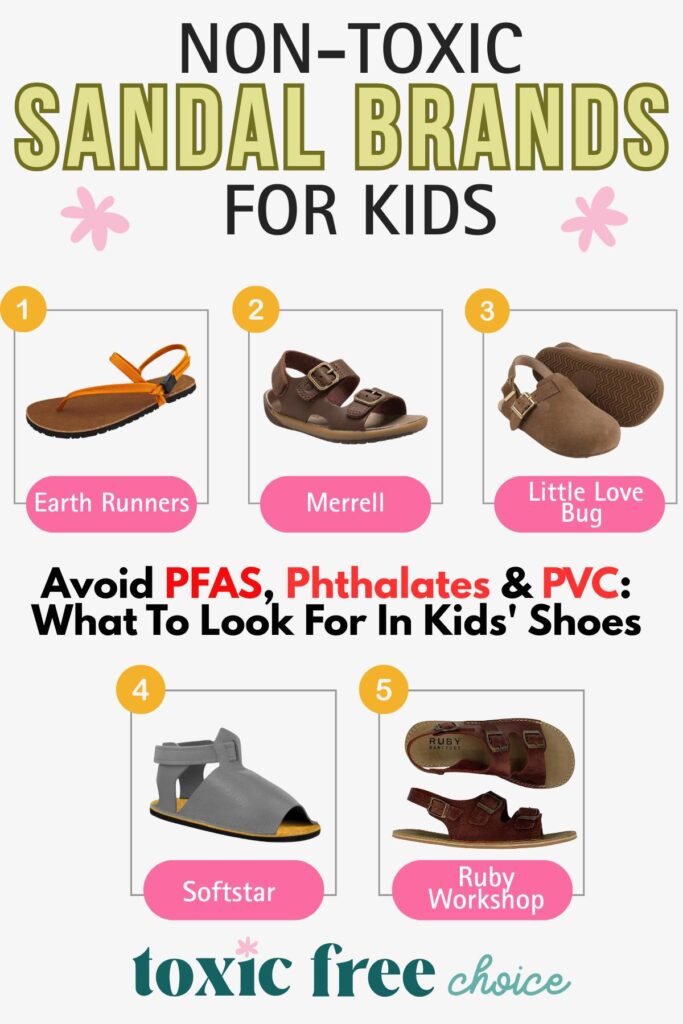
The 5 Non-Toxic Sandals That We Can Safely Recommend
- Earth Runners’ Children’s Minimalist Sandals (Save 10% with code TFC)
- Merrell’s Bare Steps Sandals
- Little Love Bug’s Beck Sandal (Save 10% with code TFC10)
- Softstar’s Laguna Sandal
- Ruby Workshop’s Handmade Leather Sandals
🌿 Related: If you’re also shopping for yourself, check out our Non-Toxic Sandals for Adults.
More Good Options (But Not Quite Great)
These may be better than most, but didn’t meet our full criteria:
- Ten Little Splash Sandals: EVA midsole
- Vivobarefoot Ultra II Kids: No full disclosure/testing
❌ Popular Toxic Kids Sandals To Avoid
While some children’s sandals are marketed with sustainability buzzwords or kid-friendly designs, closer inspection often reveals troubling material choices.
In the absence of mandatory disclosure laws, even familiar brands can mask the use of chemicals flagged by environmental health researchers.
❌ Melissa’s Jelly Sandal
Take Melissa’s Jelly Sandal, for example. They heavily promote the use of sustainable materials and recycled plastic, but the primary material in their jelly shoes is polyvinyl chloride (PVC), widely criticized for containing chlorine, plasticizers, and heavy metals.
PVC remains one of the most scrutinized plastics on the market for children’s products due to its potential to release dioxins and other harmful additives during wear or degradation.
❌ Old Navy
Mass-market retailers like Old Navy also draw attention from concerned advocates because they often don’t disclose what their sandals are made from.
Their low-cost sandals often rely on undisclosed plastic blends. At this price point, materials like EVA, polyurethane, and vinyl are frequently used without transparency about plasticizer content or off-gassing potential.
❌ Reef’s Little Ahi Sandals
While cute, Reef’s Little Ahi Sandals are made with polyurethane paired with polyester straps, both derived from petroleum-based compounds.
While the brand offers colorful, surf-inspired prints, there is no mention of chemical testing or independent safety certifications.
❌ Havaianas
Then there are legacy brands like Havaianas, whose Disney-themed flip-flops remain a staple in summer wardrobes.
Despite their global popularity, the company lists PVC as the main material for the straps, raising similar concerns about plasticizers and chlorine-based polymers.
Across all of these examples, the common thread isn’t one toxic ingredient; it’s an industry-wide reluctance to disclose what’s actually in their sandals.
Frequently Asked Questions
Not all, but most are problematic. EVA itself is a plastic polymer that may contain formamide and other additives. Only trust brands that provide third-party test results.
Usually not. Most vegan leathers are just plastic (PU or PVC) and contain phthalates, solvents, and coatings.
Rarely. Most low-cost sandals rely on synthetic materials. Specialty or European brands are more likely to meet safety standards.
OEKO-TEX Standard 100 and GOTS are the most reliable, but even these don’t test for everything. Use them as a guide, not a guarantee.
Not necessarily. Used synthetic sandals may have already off-gassed some chemicals, but they can still contain toxins. Natural material sandals age better and are usually safer secondhand.
Yes. Denmark, France, and the EU are more proactive in banning certain chemicals like formamide in children’s foam products.
The smell and feel test. If it smells like plastic or chemicals, feels overly soft or sticky, or looks shiny and synthetic—it probably contains hidden toxins.
The Bottom Line on Non-Toxic Children’s Sandals
Behind the colorful straps and cheerful branding, many kids’ sandals contain plasticizers, PFAS, VOCs, and undisclosed adhesives. They’re worn during peak absorption conditions—heat, sweat, and friction.
Unlike toys, sandals are unregulated. No required disclosures. No chemical limits. No safety testing. Companies can call their shoes “non-toxic” and fill them with synthetic toxins.
Until laws catch up, it’s on us to:
- Ask hard questions
- Choose natural materials
- Support brands that prioritize safety
Our kids deserve better than being test subjects for the footwear industry.
🔥 More Non-Toxic Summer Must-Reads:
- Non-Toxic Backyard Play Ideas
- Non-Toxic Essentials for a Safe Summer
- Low-Tox Raincoats & Non-Toxic Rainboots For Kids
- Non-Toxic Swimsuits For The Whole Family
- Non-Toxic Sunscreen For Babies & Kids
- Non-Toxic & Lead-Free Water Bottles
- Non-Toxic Shampoo & Conditioner
- DEET-Free Non-Toxic Bug Spray
- Non-Toxic Fashion For Kids
- Non-Toxic Body Soap Bars
- Non-Toxic Lunch Boxes
- Non-Toxic Deodorant
- Non-Toxic Kids Cups
- Organic Backpacks
Like It? Pin It!
Sources
- Abafe, O. A., Harrad, S., & Abdallah, M. A. E. (2023). Novel insights into the dermal bioaccessibility and human exposure to brominated flame retardant additives in microplastics. Environmental Science & Technology, 57(14), 5313–5325. https://doi.org/10.1021/acs.est.3c01894
- American Cancer Society. (2024). Formaldehyde and cancer risk. https://www.cancer.org/cancer/risk-prevention/chemicals/formaldehyde.html
- ANSES. (2016). Characterization of consumer exposure to substances contained in textile articles (Report No. CONSO2014SA0237RaEN). https://www.anses.fr/en/system/files/CONSO2014SA0237RaEN.pdf
- Arnika. (2016, August 26). Children summer shoes? They often contain toxic lead and hazardous phthalates. https://arnika.org/en/news/children-summer-shoes-they-often-contain-toxic-lead-and-hazardous-phthalates
- Credence Research. (2023). Footwear sole material market: Growth, trends, COVID-19 impact, and forecasts (2023–2028). https://www.credenceresearch.com/report/footwear-sole-material-market
- Danish Environmental Protection Agency. (2010). Survey and health assessment of the exposure of children to chemical substances in footwear (Environmental Project No. 1327 2010). https://www2.mst.dk/udgiv/publications/2010/978-87-92708-67-0/pdf/978-87-92708-66-3.pdf
- Johnson, S. L., & Li, W. W. (2023). Microplastics and human health: A review of published data. International Journal of Environmental Research and Public Health, 20, 3340. https://pubmed.ncbi.nlm.nih.gov/36988557/
- Patisaul, H. B., & Adewale, H. B. (2009). Long-term effects of environmental endocrine disruptors on reproductive physiology and behavior. Frontiers in Behavioral Neuroscience, 3, 10. https://pmc.ncbi.nlm.nih.gov/articles/PMC5227115/
- SATRA. (n.d.). An overview of sole materials and construction. SATRA Bulletin. Retrieved July 29, 2025, from https://www.satra.com/bulletin/article.php?id=1011
- Sarker, M., & Nahar, N. (2016). Toxic elements in textile and their assessment. Textile Research Journal, 86(16), 1758–1765. https://doi.org/10.1177/0040517516639816
- Toxic-Free Future. (2014, April 29). There’s WHAT in those little shoes? https://toxicfreefuture.org/blog/theres-what-in-those-little-shoes-2/
- Wang, Y., Qian, Q., Chen, J., & Chen, F. (2020). The impact of microplastics on the human body: A review. Frontiers in Public Health, 8, 156. https://pmc.ncbi.nlm.nih.gov/articles/PMC7121289/