This post may contain affiliate links. By browsing this website, you agree to our disclaimer, privacy policy, and terms of use.
Teflon revolutionized modern cooking—but decades later, we’re still learning the cost.
Behind the promise of nonstick convenience lies a complex web of toxic PFAS chemicals, misleading labels, and long-term health risks.
Today, nearly 80% of nonstick pans still contain PTFE, the compound behind Teflon—and many “PFOA-free” claims are more marketing than meaningful safety.
This guide breaks it all down: what Teflon really is, how it relates to PFAS, what the science says about PTFE, and which cookware alternatives are truly non-toxic.
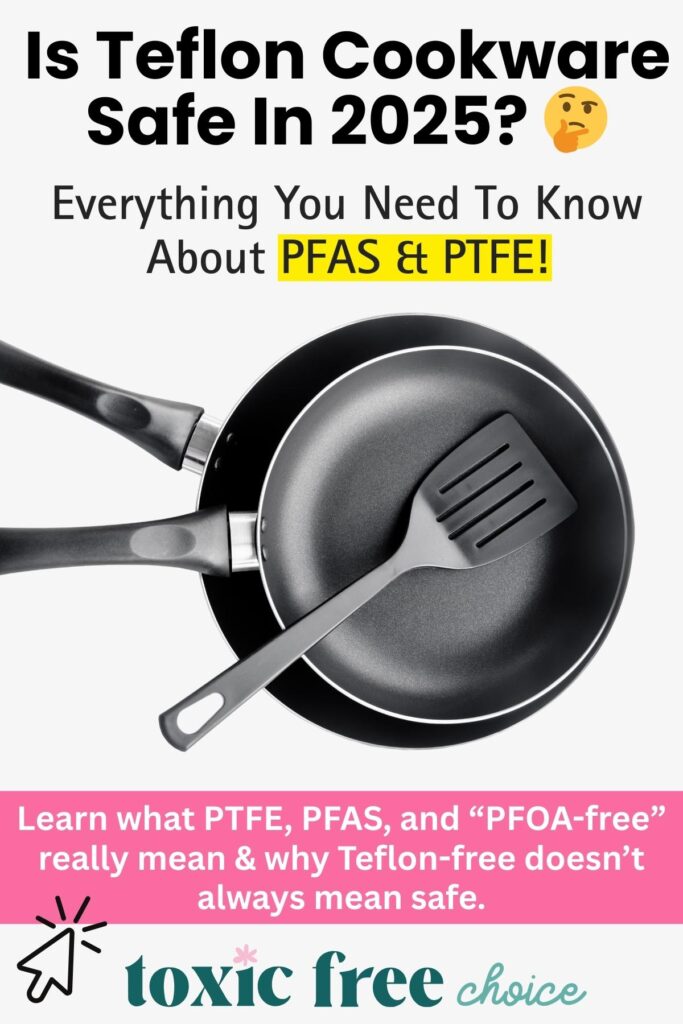
You’ve probably heard by now that you shouldn’t be cooking with Teflon-coated pans — they’re not great for your health.
So you’re trying to do the right thing and pick safe, non-toxic cookware for your family. But when you start shopping, you’re met with labels like: “PFOA-free.” “PTFE-free.” “Non-toxic.” “Safe for everyday cooking.”
And you’re left wondering what those claims actually mean? And can they be trusted?
For decades, Teflon-coated pans were kitchen staples. They made eggs slide, cleanup easy, and cooking feel effortless. It felt like a miracle for the modern kitchen.
But like many modern conveniences, the truth behind Teflon was too good to be true.
It took nearly half a century for the real risks to surface — including toxic chemical exposure, decades of lawsuits, and mounting health concerns.
And even now, clear information and meaningful regulation are still lagging behind.

Best Non-Toxic Cookware Alternatives (2026)
If you’re ready to ditch chemical coatings altogether, these cookware materials are durable, PFAS-free, and trusted by chefs and families alike.
Cast Iron
Naturally nonstick when properly seasoned, cast iron is oven-safe, chemical-free, and nearly indestructible. It improves with use and can last a lifetime.
👉 Try Our Top Pick: Field Company cast iron cookware – lightweight, USA-made, and heirloom quality.
Stainless Steel
Scratch-resistant, non-reactive, and ideal for browning, sautéing, and deglazing. Stainless steel has a learning curve, but once mastered, it’s one of the most versatile and durable options.
👉 Explore Our Favorite: 360 Stainless Steel Cookware (Use code TFC15 for 15% off) – PFAS-free, waterless cooking, made in the USA.
Titanium
Our Place’s titanium cookware line offers a PFAS-free, PTFE-free alternative to traditional nonstick—with no sprayed-on coatings. It uses bonded titanium without fluorinated chemicals, offering long-lasting performance and high heat tolerance.
👉 Check It Out: Our Place titanium cookware – nontoxic, coating-free, and safe at any temperature.
Glass
Excellent for baking, roasting, and reheating. Glass cookware is completely free from PFAS, PTFE, and heavy metals. Just avoid thermal shock and always verify lead-free certification.
👉 Try This Favorite: Anchor Hocking glass bakeware – affordable, lead-free, and oven-safe.
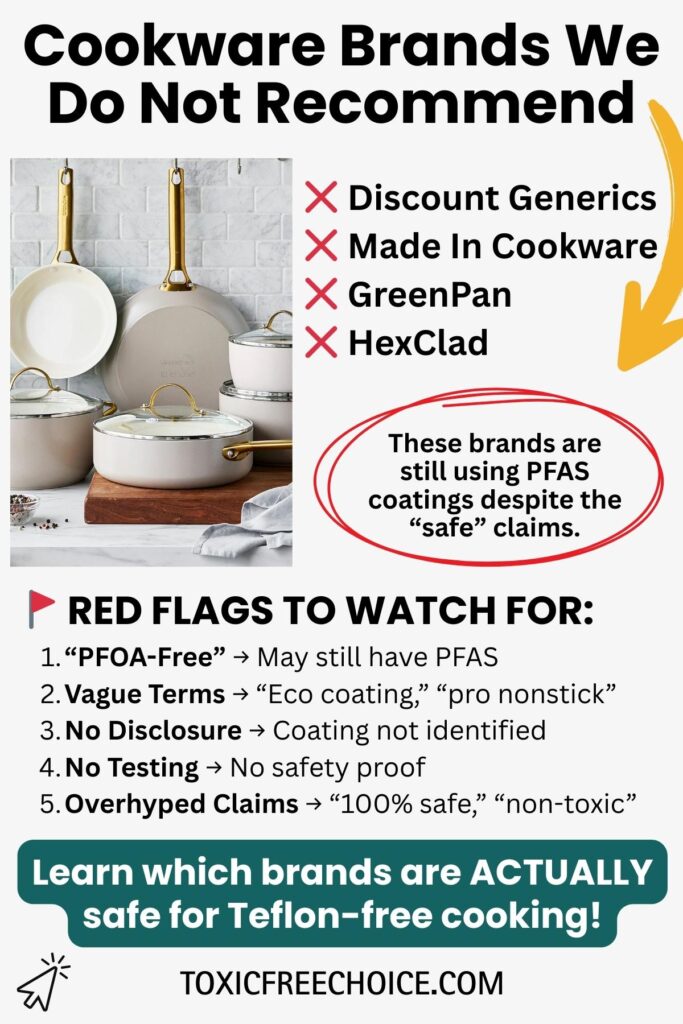
⚠️ Cookware Brands We Do Not Recommend
Some cookware brands continue to use PFAS-based coatings while advertising their products as “safe” or “PFOA-free.” Here are a few examples to approach with caution:
- HexClad – Marketed as “safe” and “non-toxic,” but contains PTFE and has faced lawsuits over misleading marketing.
- Made In Cookware – Previously sued for falsely labeling PTFE-coated pans as “100% non-toxic.”
- GreenPan – Often advertised as “eco nonstick,” but not all lines are fully PFAS-free; transparency varies.
- Discount Store Brands – Many pans from retailers like HomeGoods, TJ Maxx, and Amazon generics lack full material disclosure and may use unnamed fluoropolymers.
🚩 Red Flags To Watch For:
- Vague phrases like “professional nonstick,” “eco coating,” or “advanced technology” without ingredient transparency
- “PFOA-free” labeling that doesn’t mention PFAS, PTFE, or fluorinated compounds
- No third-party testing or material disclosures on product pages
Want peace of mind? Stick to fully vetted cookware brands we’ve tested for PFAS-free safety.
Why “Teflon-Free” Doesn’t Mean Much
Many brands stopped using the DuPont-owned Teflon name but kept using PTFE, just under different proprietary names.
They just removed the brand name, but kept using the same toxic compound.
Worse yet, many companies use greenwashing techniques. Some product packaging implies PFAS-free safety through green logos, vague health claims, or eco-marketing, but a closer look at the fine print often reveals that PTFE coatings are still in use.
The result? We, the consumers, are trying to make safer choices, but are often misled by the labeling
👉 Explore our 100% PFAS-free cookware picks—tested, vetted, and truly non-toxic.

The PFOA vs. PTFE vs. PFAS Confusion
For decades, manufacturers used PFOA, a toxic “forever chemical,” to produce PTFE, the slick nonstick compound better known by its brand name, Teflon.
While PFOA wasn’t part of the final cookware surface, it contaminated water supplies, built up in the human body, and was linked to cancer, infertility, liver damage, and other serious health concerns.
After lawsuits and mounting scientific evidence, U.S. companies finally phased out PFOA by 2013. But the nonstick coating itself—PTFE—remained.
Manufacturers simply replaced PFOA with other PFAS chemicals, allowing them to slap on “PFOA-free” labels without changing the core material.
So what’s the difference?
- Teflon is the brand name.
- PTFE is the nonstick coating it refers to.
- PFOA was a processing aid used to make PTFE.
- PFAS is the broader family of chemicals that includes both PTFE and PFOA.
In other words, most “PFOA-free” cookware still contains PFAS—just in a different form.
PTFE coatings can begin breaking down at around 500°F, releasing toxic fumes that cause polymer fume fever (a flu-like illness often misdiagnosed).
In 2023, poison control centers reported a spike in cases tied to overheated nonstick pans.
And if your pan is scratched? A single flake can release millions of microplastic particles into your food during cooking—adding a whole new layer of concern.
So when a label says “PFOA-free,” it doesn’t mean safe. It just means one dangerous chemical was removed—while the risks of PFAS exposure, toxic fumes, and microplastics remain.

Health Risks Linked To Teflon
The health concerns around Teflon aren’t just history—they’re ongoing. From toxic fumes to microplastics and hormone-disrupting PFAS exposure, the risks stack up.
PTFE Today: Still Part of the PFAS Family
While PFOA has been phased out, PTFE (the chemical name for Teflon) is still used in most nonstick cookware. It’s also a PFAS, and the safety concerns didn’t disappear with the label change.
PTFE coatings begin to degrade at around 500°F—a temperature easily reached on a stovetop.
Overheating can release toxic fumes that cause polymer fume fever, with symptoms like chills, coughing, and chest tightness.
In 2023, poison control centers recorded a spike in cases tied to overheated nonstick cookware.
New Concern: Microplastics from Scratched Pans
A 2022 study found that scratched PTFE coatings can shed up to 2.3 million microplastic particles into food during normal use.
These aren’t the same as BPA—they’re tiny solid fragments of fluoropolymer coating.
While the health impact is still being researched, scientists warn that these particles can accumulate in the body over time.
The Global Shift: Where Regulations Stand Now
Some governments are finally acting. Here’s where PFAS regulation stands:
- California: Requires cookware brands to disclose PFAS on product labels
- Maine: Plans to ban all non-essential PFAS by 2030
- France: Banned PFAS-containing cookware starting in 2025
- European Union: Considering sweeping PFAS bans across industries
In contrast, the U.S. has no federal ban on PTFE in cookware. Most brands continue to label products “PFOA-free” while quietly using PFAS-based coatings.
Mis-Leading Non-Toxic Claims (& Lawsuits)
Even when consumers try to make safer choices, misleading labels and greenwashing can get in the way. A key example is the 2022 class-action lawsuit filed against Made In Cookware.
The company marketed its PTFE-coated pans as “100% non-toxic” despite the fact that heating PTFE can release toxic fumes and the coating itself is part of the PFAS chemical family.
According to the complaint and third-party testing, the pans:
- Contained detectable levels of PFOA, despite being marketed as “PFOA-free”
- Used PTFE coatings, capable of shedding microplastics and releasing fumes under high heat
- Showed visible scratching and flaking in consumer use, with particles entering the food
The lawsuit highlighted how some brands use claims like “PFOA-free” and “non-toxic” to suggest safety while still relying on PFAS-class chemicals. This isn’t just misleading; it leaves consumers vulnerable.
Advocacy & Regulatory Pushback
Groups like Consumer Reports, the Environmental Working Group, and independent testing labs have played a major role in uncovering these inconsistencies.
Their research has shown a clear gap between brand messaging and actual material safety.
At the same time, growing public pressure and litigation have pushed some states and cookware brands toward greater transparency.
- California now requires brands to disclose PFAS in cookware
- Maine plans to ban all non-essential PFAS by 2030
- France has already banned cookware containing PFAS, effective in 2025
- Some cookware brands have begun shifting toward verified PFAS-free materials in response to consumer demand
Want to see which brands are actually moving in the right direction? Check out SKL’s Safest Non-Toxic Cookware Brands for trusted, PFAS-free alternatives.
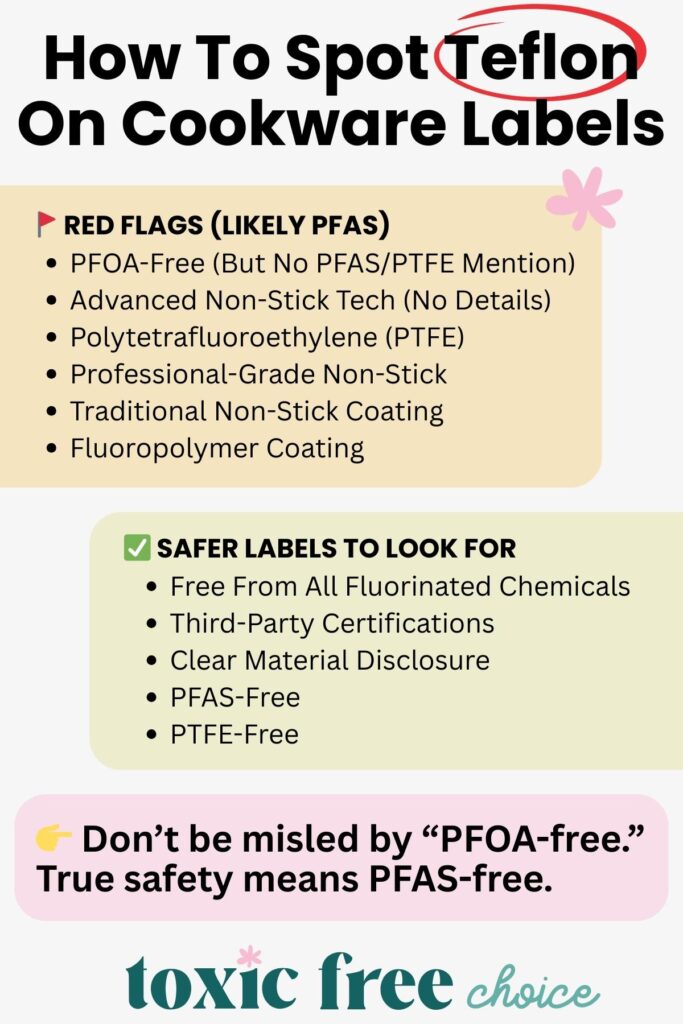
How To Spot Teflon (& PFAS) In Cookware Labels
Cookware labels can be confusing and sometimes deliberately misleading. Manufacturers don’t always make it easy to tell whether their products contain PFAS chemicals like PTFE.
But with a few key phrases and red flags, you can get better at spotting Teflon-coated cookware in disguise.
Watch For These PFAS-Related Terms
If you see any of the following terms, there’s a good chance the product contains PTFE or another PFAS-based nonstick coating:
- Polytetrafluoroethylene (PTFE)
- Fluoropolymer coating
- Traditional nonstick coating
- Professional-grade nonstick
- Advanced nonstick technology (with no material listed)
- PFOA-free (without mentioning PFAS or PTFE)
These phrases are often used to downplay or obscure the use of PFAS while still marketing a product as safe or eco-friendly.
Transparency Is Key
Brands that offer genuinely safer cookware are usually proud to say so. Look for labels or product descriptions that clearly state:
- “PFAS-free”
- “PTFE-free”
- “Free from all fluorinated chemicals”
- Third-party certifications like GreenScreen
If a brand doesn’t provide coating information on the product page or packaging, or if they cite “proprietary coating” without specifics, that’s a red flag.
If you are concerned about the materials used, we always suggest reaching out directly to a company’s customer service department with any questions.
If they can’t give you a straight answer, it’s safest to move on.
👉 You Might Also Like:
Frequently Asked Questions
Yes, most nonstick pans sold today still use PTFE, the chemical behind Teflon. Even if a product is labeled “Teflon-free,” it may still contain PTFE under another name.
Teflon is a brand name. PTFE is the actual chemical used for nonstick coatings. PFOA was a toxic chemical once used to manufacture PTFE, but it has been phased out. PFAS is the broader class of over 9,000 related chemicals, including both PTFE and PFOA.
No, “PFOA-free” only means that one specific chemical was removed. Most cookware labeled this way still contains PTFE, which belongs to the PFAS family and carries similar risks.
Yes, PTFE begins to break down around 500 degrees Fahrenheit. At that point, it can release toxic fumes that may cause a flu-like condition called polymer fume fever. These fumes are especially dangerous for birds and can also impact human health in closed environments.
Yes, research shows that scratched PTFE coatings can release thousands to millions of microplastic particles into your food while cooking. These particles may build up in your body over time.
It is not recommended. Cookware made before 2013 likely contains PFOA, a toxic chemical that was phased out due to serious health concerns. Even if the coating appears intact, older nonstick pans pose a higher risk and should be replaced.
No, Teflon-coated pans should not be recycled or donated. They can leach PFAS into new environments. Instead, wrap them in paper and dispose of them in the trash according to local guidelines.
Some are, but it depends on the materials used. Safe ceramic pans will be clearly labeled as PFAS-free, PTFE-free, and heavy-metal-free. Always look for third-party testing or safety certifications to confirm.
Cast iron is naturally nonstick and chemical-free. Stainless steel is durable and safe at high temperatures. Our Place’s titanium cookware offers a PFAS-free option with no sprayed-on coatings. Glass cookware is another reliable choice for baking and roasting.
Look for transparency on the label. If the packaging uses vague terms like “eco nonstick” or only says “PFOA-free” without mentioning PTFE or PFAS, the pan likely contains fluorinated chemicals. Safer brands will state “PFAS-free” or “PTFE-free” clearly.
PFAS chemicals are linked to cancer, hormone disruption, immune issues, fertility problems, and developmental delays. Cookware is one of the most common and direct ways people are exposed to these toxic compounds in daily life.
Final Thoughts: Is It Time To Ditch Teflon for Good?
After decades of trusting “PFOA-free” labels, we now know that swapping one PFAS for another doesn’t mean safer cookware.
Research confirms that PTFE, the active ingredient in Teflon, is part of the same persistent chemical family and can release toxic fumes or microplastics under everyday cooking conditions.
From scratched pans to overheated skillets, real-world use shows how easily these “forever chemicals” can enter our food, our homes, and our bodies.
The good news is you have options. Safer materials like cast iron, stainless steel, and verified ceramic cookware eliminate PFAS exposure entirely.
When nonstick is essential, look for clear “PFAS-free” or “PTFE-free” labels and skip vague claims like “eco nonstick” or “PFOA-free.”
With better information and better cookware, you can move beyond misleading marketing, protect your health, and cook with confidence.
If you’re ready to part ways with Teflon, you’re not alone. Plenty of PFAS-free options now exist for nearly every appliance and cookware need.
When you choose PFAS-free cookware, you’re protecting your health, your home, and your planet. You’re also sending a message that toxic shortcuts are no longer acceptable.
Check out our other amazing Non-Toxic Kitchen articles:
- Non-Toxic Baking Accessories
- Non-Toxic Kitchen Utensils
- Non-Toxic Cutting Boards
- Non-Toxic Coffee Makers
- Non-Toxic Grilling Gear
- Non-Toxic Dinnerware
- Non-Toxic Tea Kettles
- Non-Toxic Cookware
- Non-Toxic Air Fryers
Like It? Pin It!
References:
- California State Legislature. (2021). AB-1200 Cookware: Hazardous chemicals: Disclosure and safety. California Legislative Information. https://leginfo.legislature.ca.gov/faces/billTextClient.xhtml?bill_id=202120220AB1200
- ChemSec – International Chemical Secretariat. (2022, February 10). The Teflon chemical PTFE is often touted as a safe cousin of toxic PFAS. But is it really? https://chemsec.org/the-teflon-chemical-ptfe-is-often-touted-as-a-safe-cousin-of-toxic-pfas-but-is-it-really/
- Ecology Center. (2020, December 8). What’s cooking? Nonstick pan study 2020 – Undisclosed PFAS coatings are common on cookware. https://www.ecocenter.org/our-work/healthy-stuff-lab/reports/whats-cooking/whats-cooking-nonstick-pan-study-2020
- German Federal Institute for Risk Assessment. (2025, February 7). No adverse health effects to be expected from cookware with PTFE non-stick coating – Q&A. https://www.bfr.bund.de/en/questions_and_answers_on_cookware_with_a_non_stick_coating_made_of_ptfe-127565.html
- Health and Environment Alliance. (2023). Increasing evidence of PFAS health impacts. In the Ban PFAS campaign. https://www.env-health.org/banpfas/
- Kindelan, K., & Salzman, S. (2024, July 26). What to know about “Teflon flu” amid a rise in cases in the US. ABC News. https://abcnews.go.com/GMA/Wellness/teflon-flu-amid-rise-cases-us/story?id=112306317
- Luo, Y., Gibson, C. T., Chuah, C., Tang, Y., Naidu, R., & Fang, C. (2022). Raman imaging for the identification of Teflon microplastics and nanoplastics released from non-stick cookware. Science of The Total Environment, 851, 158293. https://doi.org/10.1016/j.scitotenv.2022.158293
- Mohrmann, J. (2022, December 8). Consumer Reports tests nonstick pans that claim to be free of PFAS. News4JAX – WJXT Jacksonville. https://www.news4jax.com/food/2022/12/08/consumer-reports-tests-nonstick-pans-that-claim-to-be-free-of-pfas/
- National Capital Poison Center. (n.d.). Protect yourself from “Teflon flu” (polymer fume fever). https://www.poison.org/articles/teflon-flu
- Pet Poison Helpline. (n.d.). Teflon (Polytetrafluoroethylene) poisoning in birds. VCA Animal Hospitals. https://vcahospitals.com/know-your-pet/teflon-polytetrafluoroethylene-poisoning-in-birds
- Science History Institute. (n.d.). Roy J. Plunkett (1910–1994). https://www.sciencehistory.org/education/scientific-biographies/roy-j-plunkett
- U.S. Environmental Protection Agency. (2022). Our current understanding of the human health and environmental risks of PFAS. https://www.epa.gov/pfas/our-current-understanding-human-health-and-environmental-risks-pfas
- Wright, M. (2022, December 12). Made In Cookware lied about the use of harmful ‘forever chemicals’ in non-stick cookware, class action alleges. ClassAction.org. https://www.classaction.org/blog/made-in-cookware-lied-about-use-of-harmful-forever-chemicals-in-non-stick-cookware-class-action-alleges