This post may contain affiliate links. By browsing this website, you agree to our disclaimer, privacy policy, and terms of use.
Have you ever picked up a product labeled “non-toxic” or “natural” and felt a little too reassured by the pretty packaging? You’re not alone.
Greenwashing has become one of the most profitable marketing tactics of our time—especially when it targets parents and health-conscious shoppers.
In 2026, brands know exactly how to make unsafe products look clean. They slap on feel-good labels, hide toxic ingredients under vague terms like “fragrance” or “eco-friendly”, and count on you not checking the fine print.
The result? You pay more for products that can still contain hormone disruptors, carcinogens, and other harmful chemicals.
This guide will show you how to spot fake “non-toxic” claims before they end up in your home—so you can protect your family, avoid marketing traps, and choose products backed by real safety, not just clever wording.
In 2024 alone, brands paid more than $700 million in settlements for misleading safety claims.
And more than half of all “eco” marketing today contains information that is either inaccurate, incomplete, or intentionally deceptive.
Picture this: you’re standing in the store aisle, cart handle under your palms, scanning shelves lined with bottles labeled eco-friendly, all-natural, or non-toxic.
The pastel colors and leafy illustrations make you feel reassured. You toss one into your cart, believing you’ve made the right choice for your family.
But the truth? You might have just brought home parabens, phthalates, or synthetic fragrance compounds linked to hormone disruption, respiratory irritation, or worse.
And this isn’t paranoia—it’s proven. In the past year alone:
- Johnson & Johnson paid $700 million for misleading claims about talcum powder safety.
- Walmart was fined $5.5 million for selling rayon as “eco-friendly bamboo.”
- Procter & Gamble is facing an $800 million lawsuit over deceptive forest protection promises.
And those are just the ones that got caught.
Globally, the deception runs far deeper. A U.S. study found that users of everyday personal care products—shampoo, lotion, perfume—are exposed to 100+ carcinogenic or hormone-disrupting chemicals per day.
In the European Union, 53% of “green” claims are misleading and 42% are outright false.
This isn’t just a marketing problem—it’s a public health problem. And it’s why understanding what greenwashing actually is is the first step in protecting your family.
⚠️ Why “Non-Toxic” & “All Natural” Aren’t Always Safe
As much as we’d love to believe brands have our best interests at heart, “non-toxic” and “all natural” are not safety guarantees.
In reality, these terms are often sophisticated marketing tricks—not proof of product safety. More often than not, they’re a red flag that it’s time to dig deeper, check the ingredient list, and question what’s really inside.
🌿 The “Natural” Trap You Didn’t See Coming
The word “natural” has no legal definition, no required testing, and no real oversight.
Many brands slap it on products when as little as 5% of the formula is plant-based, filling the rest with synthetic chemicals that boost profits.
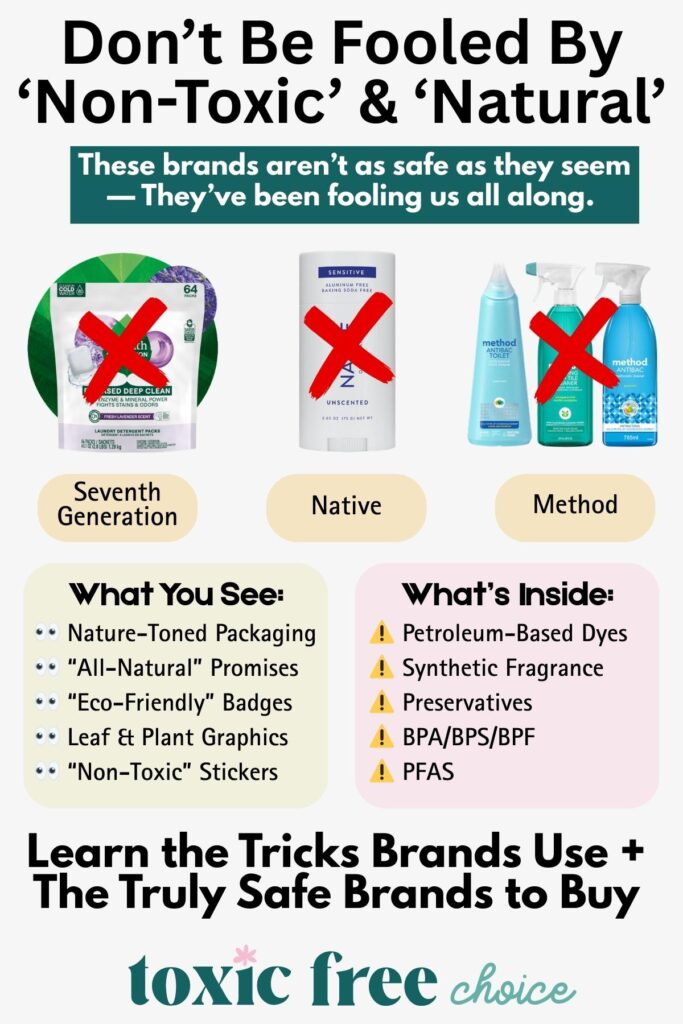
Example: Deodorants like Native market themselves as free from sulfates and parabens, but have faced scrutiny and legal attention for allegedly containing PFAS—the toxic “forever chemicals” linked to long-term health risks.
👉 For safer swaps, see our Best Non-Toxic Deodorants — tested for PFAS, synthetic fragrance, and hormone disruptors.
🚫 “Non-Toxic” Is Not the Safe Label You Think
Does “non-toxic” mean safe?
Nope. Just like “natural” or “eco-friendly”, it’s not legally regulated and can mean something completely different depending on the brand.
Example: Method paid $2.25 million for marketing its products as “non-toxic” while containing methylisothiazolinone (MIT)—a toxic skin irritant banned in Europe, Canada, and Japan.
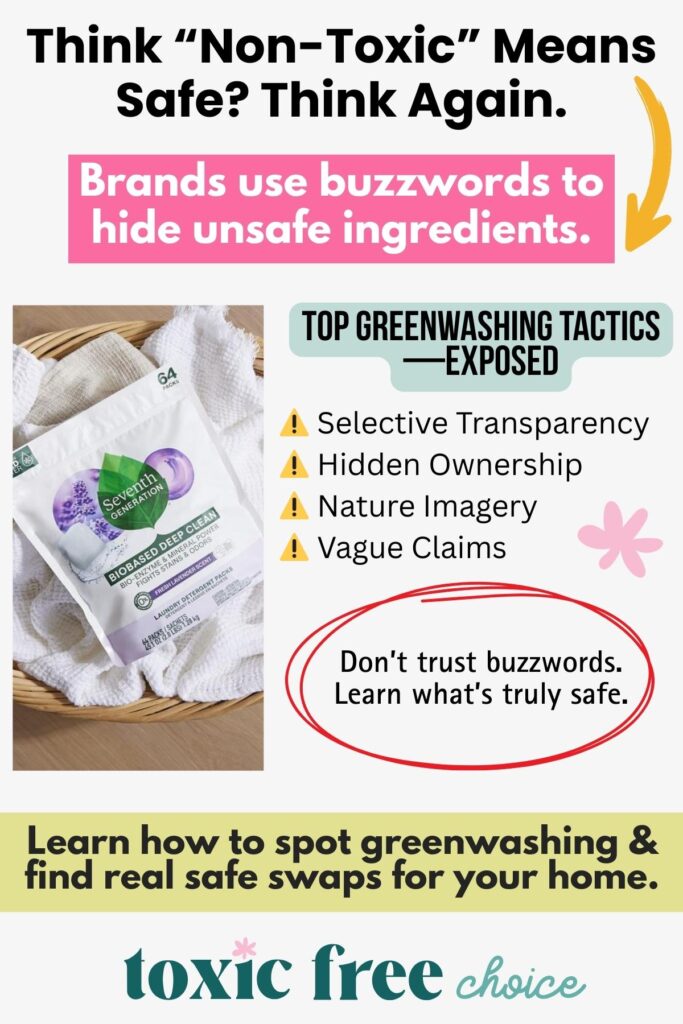
And it’s not just Method. Seventh Generation, owned by Unilever, is still marketed as eco-conscious but contains undisclosed preservatives, synthetic surfactants, and vague claims like “safe for your family”—without independent third-party testing.
👉 Looking for safe swaps? See our Best Non-Toxic Cleaning Brands for truly tested options.
🥤 When “Safer” Alternatives Turn Out to Be Worse
Some so-called safer alternatives can actually be more dangerous than what they replaced.
Example: Many “BPA-free” plastics—like those from Dr. Brown, Nuk, Philips Avent, and Tommee Tippee—use BPS or BPF instead.
The EPA found these alternatives can have equal or stronger estrogenic activity than BPA, and baby bottles made from them release microplastics when heated.
👉 Protect your baby — see our Safest Non-Toxic Baby Bottles made from glass and stainless steel.
The same bait-and-switch happens in cookware. “PFOA-free” pans often still contain PTFE, the chemical name for Teflon, which releases toxic fumes at high heat and can lead to serious illness.
👉 Upgrade your kitchen with our Best Non-Toxic Cookware Brands — 100% free from PFAS, PFOA, and PTFE.
Why does it happen? Because replacing harmful materials with truly safe alternatives costs more, some brands would rather risk your health than risk their profits.
Common Greenwashing Tactics & Phrases to Avoid
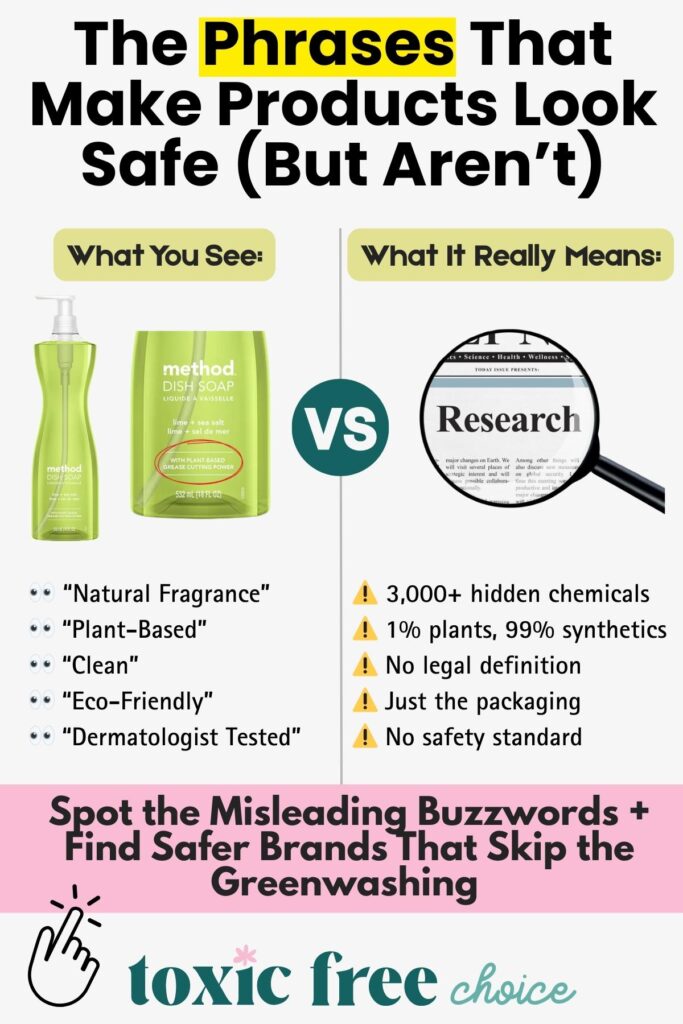
⚠️ The Hidden Danger of “Natural Fragrance”
Fragrance is one of the most common—and most deceptive—greenwashing tactics.
Even on products labeled “clean,” “non-toxic,” or “natural”, that one word can legally hide over 3,000 undisclosed chemicals.
Many brands make scents sound naturally derived (geranium, lemon verbena) to create a false sense of safety. In reality, these are often synthetic blends loaded with hormone disruptors, allergens, and carcinogens.
📊 Studies show 75% of products listing “fragrance” contain phthalates, endocrine disruptors linked to over 107,000 deaths annually.
Examples of greenwashed fragrance:
- Mrs. Meyer’s garden-inspired cleaners hide synthetic fragrance chemicals in proprietary blends.
- Dawn’s gentle dish soap contains ingredients toxic to aquatic life.
- “Unscented” products still include masking fragrances—protected as trade secrets.
If a product lists “natural fragrance” but won’t disclose ingredients, that’s a red flag.
👉 Explore our guide to the fragrance loophole & why it’s so bad for our health
👉 For skincare, check our Best Non-Toxic Skincare Brands
🚫 Meaningless Buzzwords That Mislead
Buzzwords are greenwashing’s favorite disguise:
- Plant-based — could mean 1% plants, 99% lab-made chemicals
- Clean — loosely defined, no standard safety criteria
- Eco-friendly — often about packaging, not the formula
- Dermatologist tested / Hypoallergenic — no enforceable standards
A European Commission investigation found:
- 37% of brands use vague sustainability claims without proof
- 42% make outright false green claims
👉 Learn the Most Common Toxic Chemicals in Your Home so you know what to look for.
📜 Flaunting Fake Certifications
Real certifications require independent testing, strict safety criteria, and full transparency. Fake ones? Just clever marketing.
Examples of fake or misleading certifications:
- Moonlight Slumber invented its own “Green Safety Shield” for crib mattresses—later found to contain PFAS and flame retardants.
- Target Clean excludes a short list of chemicals, but still allows others that may cause harm.
- CertiPUR-US is funded by the foam industry and permits chemicals flagged by health experts.
✅ Certifications you can trust:
- EPA Safer Choice — reviewed by EPA scientists
- OEKO-TEX® Standard 100 — strict limits on harmful substances
- MADE SAFE® — screens for thousands of known and suspected toxins
👉 See our Best Non-Toxic Furniture Brands that meet the highest certification standards.
🏢 When Big Corporations Buy “Natural” Brands
Mega-corporations like S.C. Johnson, Unilever, and Procter & Gamble often buy trusted clean brands, keep the branding, but weaken formulas and reduce transparency.
Examples:
- S.C. Johnson owns Method and Mrs. Meyer’s
- Unilever owns Seventh Generation
- Procter & Gamble owns Native and Herbal Essences BioRenew
After acquisitions, cost-cutting often replaces ingredient integrity. Always re-check labels and ingredient lists—especially if a product’s scent, texture, or performance changes.
👉 See our Safest Baby & Kids Brands for companies that remain independent and transparent.
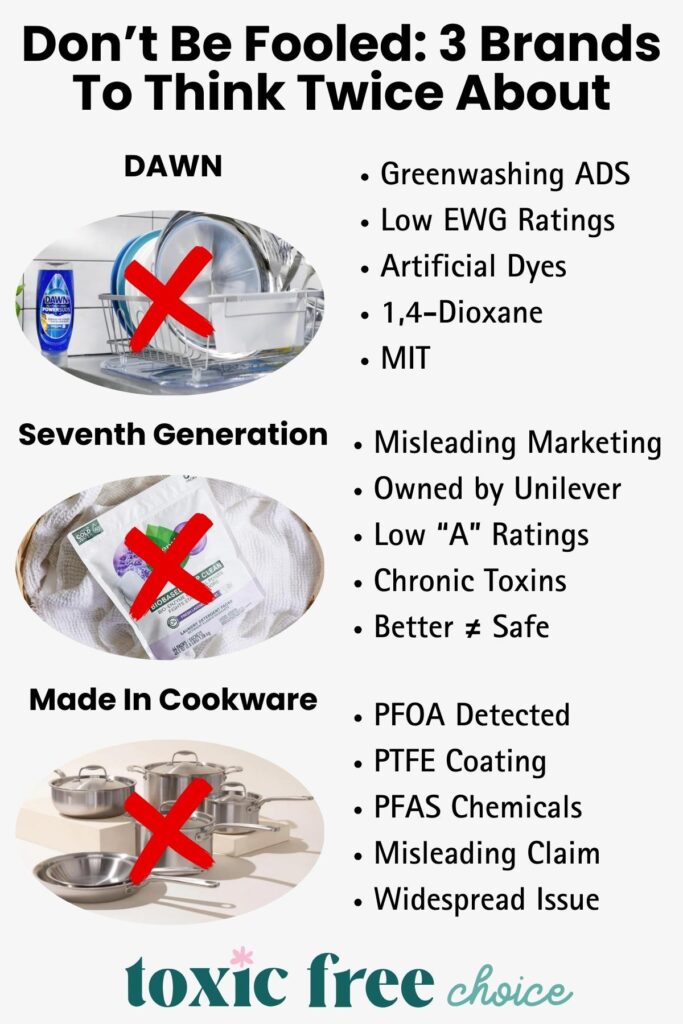
Real-World Examples of Greenwashing in the Home (Brands We Don’t Recommend)
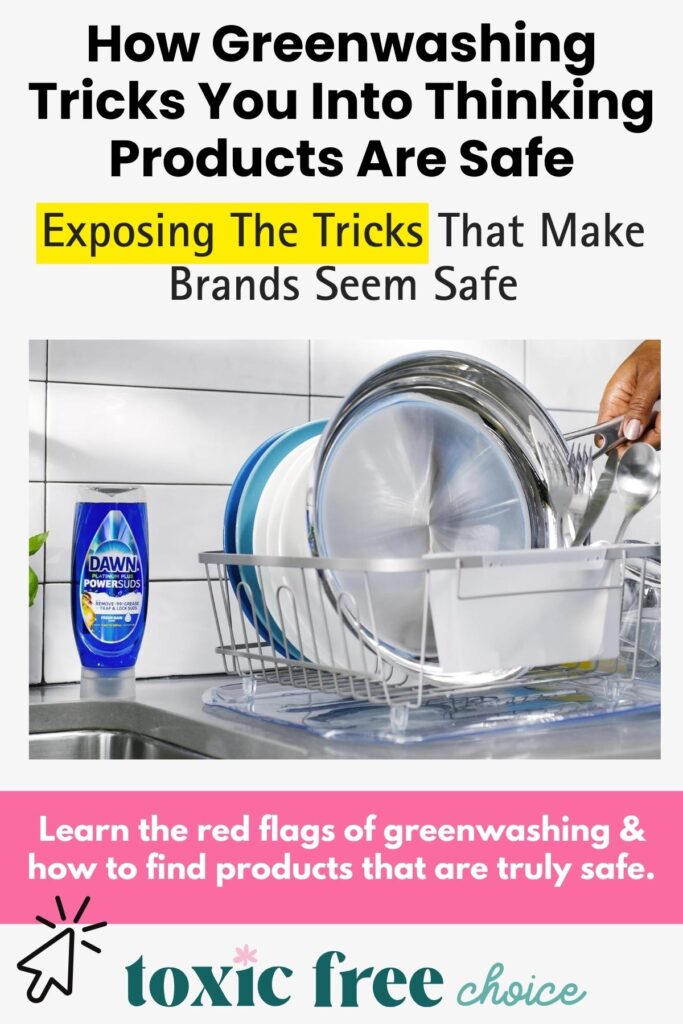
🧼 Dawn: Don’t Be Fooled by Cute Marketing
Dawn’s commercials show baby ducks being rescued with “gentle” soap. What they don’t show is what’s actually in the bottle under your sink.
EWG rates all 42 Dawn products between C and F for ingredient safety. The formula contains:
- Methylisothiazolinone (MIT) — a preservative toxic to aquatic life
- C9-11 Pareth-8 — a possible 1,4-dioxane contaminant
- Artificial dyes — linked to nervous system effects
The “wildlife rescue” soap you see on TV? It’s a special lab formula that never reaches consumers. The version you buy is a greenwashed product dressed in animal-rescue marketing.
👉 See our Best Non-Toxic Cleaning Brands for safer alternatives.
♻️ Seventh Generation: Honest Name, Dishonest Ingredients
Once a trusted eco-brand, Seventh Generation now belongs to Unilever—and its formulations raise red flags.
Their website claims they’re “working to be free of chronic toxins by 2025”—translation: they’re still using them now. Only 37% of their products get an “A” rating from EWG.
While that’s better than many brands, it’s far from the gold standard they market themselves to be. “Better than average” doesn’t mean safe.
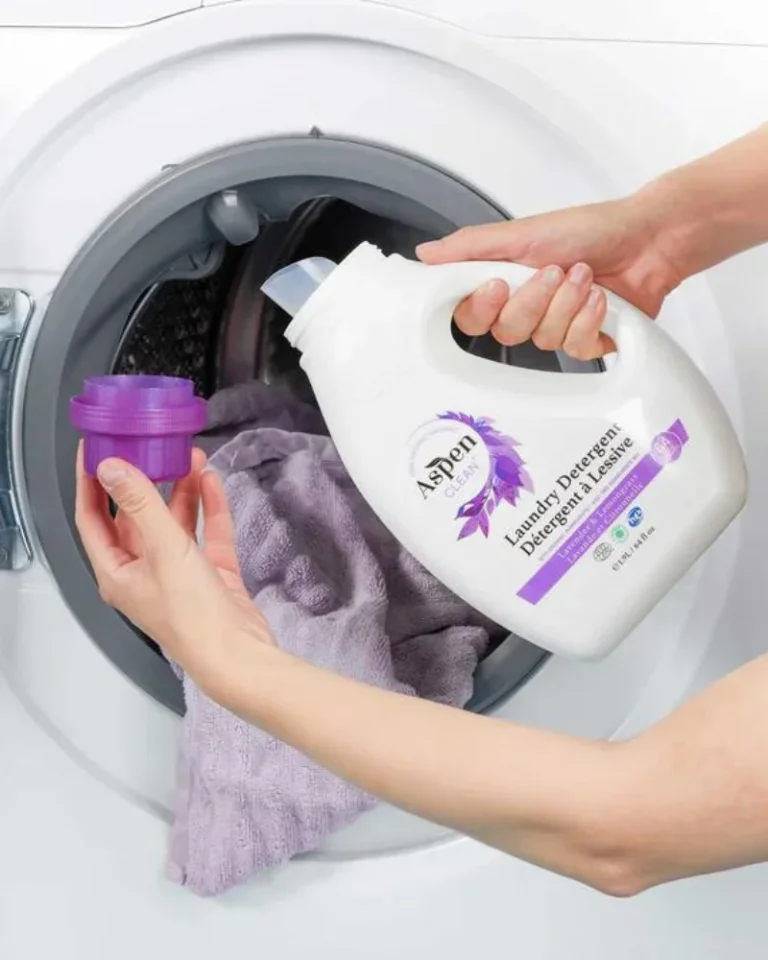
👉 See our Best Non-Toxic Laundry Detergents for safer swaps.
🍳 Made In Cookware: “Non-Toxic” That Isn’t
Made In advertises its pans as “PFOA-free” and “100% non-toxic.” But testing revealed measurable levels of PFOA—a PFAS chemical linked to cancer, thyroid disorders, and developmental toxicity.
These “forever chemicals” don’t break down in the environment and can accumulate in your body for years. And it’s not just Made In—a Danish consumer study found that many “PFOA-free” pans are still made with PTFE, the base compound in Teflon.
Bottom line: “PFOA-free” means nothing if the entire material still contains toxic fluoropolymers.
👉 See our Safest Non-Toxic Cookware Brands for PTFE- and PFAS-free options.
Greenwashing in Baby Products, Furniture & Kitchenware
👶 When Baby Products Aren’t So Cute
Parents naturally want the safest options for their kids. Unfortunately, many baby brands exploit that trust—using feel-good words like “pure,” “gentle,” and “non-toxic” to hide harmful ingredients and materials.
Don’t Trust “BPA-Free” Baby Bottles
Plastic baby bottles were once made with BPA, linked to developmental, neurological, and reproductive harm.
After BPA was banned from bottles in 2011, most companies swapped it for BPS or BPF—chemical cousins with equal or worse health risks—then slapped on “BPA-free” labels to reassure parents.
👉 Want a deeper dive into the truth about BPA, BPS & BPA-free plastics? Read this guide!
👉 See SKL’s Safest Non-Toxic Baby Bottles for glass, stainless steel, and silicone options that are 100% free from bisphenols.
When Crib Mattresses & Bedding Turn Toxic
Children’s bedding is often made from polyester and nylon, treated with flame retardants, formaldehyde finishes, and heavy metal dyes—all linked to cancer, respiratory issues, and developmental harm.
Even so-called “organic” mattresses can hide PFAS and polyurethane foam. Example: L.A. Baby sold “non-toxic” mattresses later found to contain multiple harmful chemicals.
👉 For fully vetted options, see our guide to the Best Non-Toxic Kids Bedding.
Not-So-Clean Baby Wipes & Bath Products
Labels like “pure,” “gentle,” and “sensitive” don’t mean safe. Many wipes and washes contain:
- Phthalates in fragrance blends
- Ethylene oxide & 1,4-dioxane (carcinogens)
- MIT — banned in the EU for baby products
- Undisclosed synthetic fragrances
These chemicals are even more dangerous to babies’ delicate skin.
👉 Looking for safer options? Check out our guide to the Best Non-Toxic Baby Wipes!
🪑 The Hidden Dangers of Toxic Furniture
Furniture is often a major source of long-term toxin exposure—and greenwashing makes it harder to spot.
Misleading Labels & Certifications
Greenguard Gold is good—but it might only apply to one component (like the frame), not the paint or adhesives. CertiPUR-US? Industry-funded and still allows VOCs that off-gas for years.
👉 See SKL’s Safest Non-Toxic Furniture Brands for options tested across all materials and finishes.
The “Solid Wood” Lie
A “solid wood” label can mean only that the frame is solid wood—drawers and panels may be particleboard with formaldehyde-based adhesives, releasing carcinogenic fumes into your home.
The Flame Retardant Irony
Flame retardants, once meant to improve safety, are now linked to cancer, hormone disruption, and developmental delays. Older furniture may still contain them, even if sold under claims like “meets all safety standards.”
🍳 Greenwashing in Kitchenware: Poisoning Every Meal
“PFOA-Free” ≠ Safe
PFOA is only one chemical in nonstick coatings—PTFE (Teflon) is still present in most “PFOA-free” cookware, meaning it’s still a PFAS-based pan.
👉 See our Safest Non-Toxic Cookware Brands for PTFE- and PFAS-free options.
Bamboo Isn’t Always Better
Many bamboo utensils and boards are bound with melamine-formaldehyde resin, which can leach formaldehyde when exposed to heat, acids, or wear. Solid hardwood is the safer choice.
Recycled E-Waste in Your Spatula?
Black plastic utensils can contain recycled electronics—lead, flame retardants, cadmium, mercury—all toxic. Premium prices don’t equal safety if brands hide behind vague claims.
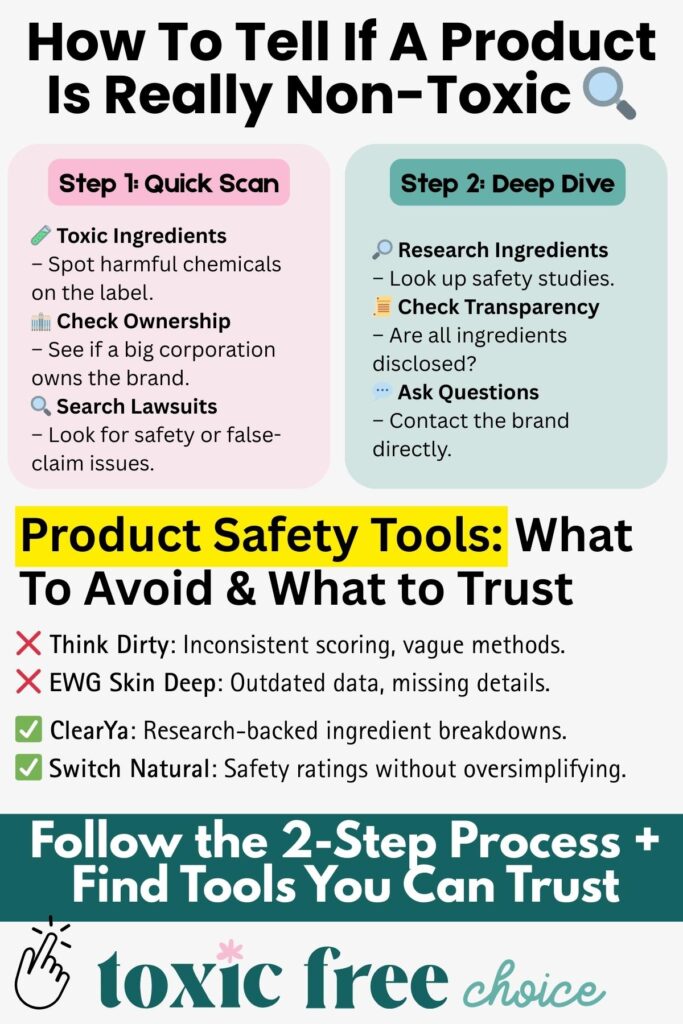
How To Check if a Product Is Really Non-Toxic
🔎 Step 1: Scan the Label
A quick scan can filter out 90% of greenwashed products.
Watch for ownership red flags: If the brand is owned by a mega corporation like S.C. Johnson, Unilever, or P&G, proceed with caution. Big corporations often keep the clean marketing but cut clean ingredients.
Check for red flag ingredients:
- Parabens: Hormone disruptors linked to increased cancer risk. Look for anything ending in “-paraben” (methylparaben, propylparaben, butylparaben).
- Phthalates: Associated with reproductive toxicity and endocrine disruption. Often hidden under “fragrance” or “parfum.”
- Formaldehyde & Formaldehyde Releasers: Known carcinogens and allergens. Common names include quaternium-15, DMDM hydantoin, imidazolidinyl urea, and diazolidinyl urea.
- Synthetic Fragrance: Can hide hormone disruptors and allergens under one vague term.
- SLS/SLES: Skin irritants that may contain toxic contaminants.
Quick Research Tip: Search the brand name plus “lawsuit” or “safety complaints” to see if there’s a history of misleading claims.
🧪 Step 2: Do a Deep Dive
If it passes the quick scan, dig deeper.
- Use PubMed: Type “[ingredient name] toxicity” or “[ingredient name] endocrine disruption” and filter by “Free full text” and “Published in the last 5 years.”
- Look For Transparency: Do they list every ingredient, disclose preservatives, and share test results? Brands that hide behind “proprietary blends” should raise red flags.
- Ask Directly: Reach out to the company. Brands that truly prioritize safety will answer ingredient questions without evasion.
❌ Tools You Shouldn’t Rely On
- Think Dirty — Inconsistent scores, no clear methodology.
- EWG Skin Deep — Limited ingredient detail and outdated product coverage.
✅ Better Alternatives
- ClearYa — Breaks down ingredient risks with research-backed explanations.
- Switch Natural — Helps you evaluate ingredient safety without oversimplifying science.
💡 Pro Tip: No app or database is perfect. Always double-check, because product formulas can change without warning.
Safer Shopping Starts Here (Your First Priority Swaps)
You’ve seen the tricks. Now let’s swap them for solutions that actually protect your family.
Not everything needs replacing at once — start with the categories that have the biggest impact on daily exposure.
Fragrance-Heavy Products
Your biggest phthalate exposure comes from anything listing “fragrance” — lotions, shampoos, cleaners, and candles.
These chemicals can stay on skin or become airborne, impacting hormones and respiratory health. Swapping fragrance-heavy products first can cut your family’s hormone disruptor load by up to 50%.
👉 Explore our guide to the fragrance loophole & why it’s so bad for our health
BPA-Free Baby Gear
Many “BPA-free” bottles still leach microplastics or use BPA replacements like BPS and BPF — both of which can be just as toxic.
These exposures are especially harmful during critical development stages. Switch to glass or stainless steel to eliminate the risk.
👉 Read our safest non-toxic baby bottles guide
Kitchen Items
That black plastic spatula? Tests have found recycled electronics inside — including lead, flame retardants, and mercury. And “PFOA-free” non-stick pans? Many are still made from toxic PTFE (Teflon).
👉 See our complete list of non-toxic kitchen utensils
👉 Find safe, non-toxic dinnerware here
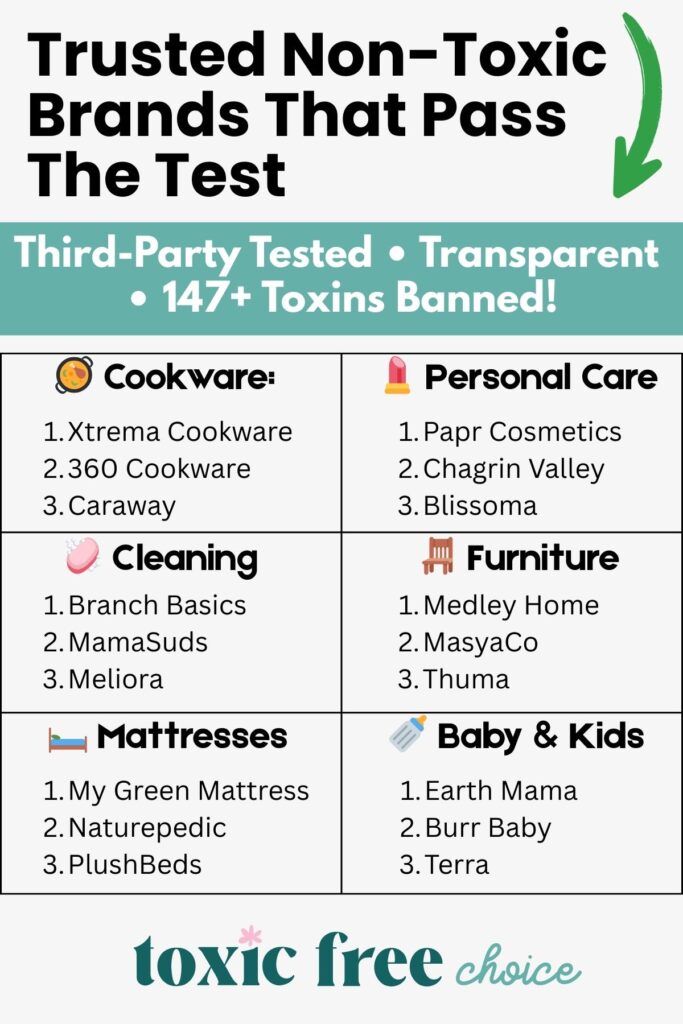
Trusted Non-Toxic Brands That Pass the Test
We’ve hand-selected brands that are 100% transparent about their materials, have rigorous third-party testing, and avoid the 147+ banned ingredients on our Toxic Free Choice list.
Non-Toxic Cookware & Utensils
- Caraway (Use code TFC10 for 10% off) — Ceramic-coated stainless steel, third-party tested
- Xtrema Cookware (Use code TFC for 15% off) — 100% ceramic cookware, no coating needed
- 360 Cookware (Use code TFC15 for 15% off) — Surgical-grade stainless steel, made in the USA
👉 See our complete list of the safest non-toxic cookware brands
Non-Toxic Furniture
- MasyaCo — Solid wood furniture handcrafted in Nicaragua with low-VOC finishes
- Medley Home — Custom sofas using natural, PFAS-free materials
- Thuma — Upcycled solid wood with non-toxic finishes, no off-gassing adhesives
👉 Explore our full list of the best non-toxic furniture brands
Organic & Non-Toxic Mattresses
- PlushBeds — GOLS latex, GOTS cotton, no chemical flame retardants
- My Green Mattress — Affordable, GOTS-certified, family-owned USA factory
- Naturepedic — MADE SAFE certified, organic cotton and steel coils
👉 See our full guide to the best organic & non-toxic mattresses
Non-Toxic Baby & Kids Products
- Earth Mama — Bath care for babies, kids, and families
- Terra — Bamboo-based baby wipes, 99.5% purified water
- Burr Baby — Glass baby bottles with silicone nipples and stainless steel components
👉 See our complete list of the best non-toxic baby products
Non-Toxic Cleaning Products
- MamaSuds — Small-batch, simple-ingredient cleaners
- Branch Basics — Concentrated, plant-based formulas
- Meliora (Use code TFC10 for 10% off) — Plastic-free, refillable, MADE SAFE certified cleaning powders
👉 Browse our full list of the best non-toxic cleaning brands
Non-Toxic Personal Care
- Blissoma — Photonic Sunscreen, non-nano zinc oxide protection
- Papr Cosmetics — Plastic-free natural deodorants
- Chagrin Valley — Organic lotion bars, handcrafted in the USA
👉 Check out our full guide to non-toxic deodorant
👉 Find safe, non-toxic lotions here
The Bottom Line
Greenwashing is everywhere — but it loses its power when you shop armed with knowledge and vetted brands. Every safe swap you make reduces daily toxin exposure and sends a message to the industry: we won’t settle for marketing over safety.
From baby bottles to cleaning sprays, deceptive marketing has made it harder to protect your family. Research confirms that many so-called safe swaps are just as harmful as what they replaced.
The good news? With better tools, you can move past the marketing and make informed decisions. Start by learning what labels actually mean. Check for trusted third-party certifications, question vague claims, and always do your own research.
Safer alternatives do exist, and when you support truly transparent brands, you help shift the industry toward honesty and health.
Looking for more non-toxic living tips? Check out these other amazing articles:
- Non-Toxic Dinnerware
- Most Common Toxic Chemicals in Your Home
- Best Non-Toxic Cleaning Brands
- Non-Toxic Baby Products
- Non-Toxic Furniture Brands
- Non-Toxic Kids Bedding
- Non-Toxic Cribs
- Non-Toxic Dish Soap
- Non-Toxic Cookware Brands
Like It? Pin It!
Sources
- Australian Industrial Chemicals Introduction Scheme. (n.d.). Methylisothiazolinone preservatives and industrial biocides: Environment tier II assessment [PDF]. https://www.industrialchemicals.gov.au/sites/default/files/Methylisothiazolinone%20preservatives%20and%20industrial%20biocides_%20Environment%20tier%20II%20assessment.pdf
- Bergfeld, W. F., Giannini, A. J., & Lei, T. (2023). Parabens and their toxicity: A review. Dermatology and Therapy, 12(1), 45-60. https://pubmed.ncbi.nlm.nih.gov/36702264/
- Beuc. (n.d.). Preventable yet everywhere: Harmful chemicals are found in all kinds of consumer products. https://www.beuc.eu/press-releases/preventable-yet-everywhere-harmful-chemicals-found-all-kinds-consumer-products
- Cancer Council Australia. (n.d.). Wood products. https://www.cancer.org.au/cancer-information/causes-and-prevention/workplace-cancer/wood-products
- Climate Case Chart. (n.d.). Giarrizzo v. Procter & Gamble Co. https://climatecasechart.com/case/giarrizzo-v-procter-gamble-co/
- Consumer Reports. (n.d.). Mattresses can be a source of harmful chemicals in kids’ rooms. https://www.consumerreports.org/babies-kids/childrens-health/mattresses-can-be-source-of-harmful-chemicals-in-kids-rooms-a5263703680/
- Danish Consumer Council. (n.d.). Frying pans are marketed with an unlawful PFAS claim. https://taenk.dk/kemi/visit-our-english-version/frying-pans-marketed-unlawful-pfas-claim
- Danish Consumer Council. (n.d.). Test of cheap jewellery for nickel release. https://taenk.dk/kemi/english/test-cheap-jewellery-nickel-release-exceeds-limit-values
- David Suzuki Foundation. (n.d.). The dirty dozen: Sodium laureth sulfate. https://davidsuzuki.org/living-green/dirty-dozen-sodium-laureth-sulfate/
- Environmental Defence Canada. (2016). Fragrance report. https://environmentaldefence.ca/wp-content/uploads/2016/01/FragranceReport.pdf
- European Commission. (n.d.). Enforcement of consumer protection: Sweeps on green claims. https://commission.europa.eu/live-work-travel-eu/consumer-rights-and-complaints/enforcement-consumer-protection/sweeps_en
- European Environment Agency. (n.d.). People’s exposure to bisphenol A. https://www.eea.europa.eu/publications/peoples-exposure-to-bisphenol-a
- European Medicines Agency. (n.d.). Cosmetics safety: Formaldehyde-releasing preservatives (JRC126061). https://publications.jrc.ec.europa.eu/repository/handle/JRC126061
- Federal Trade Commission. (2017, September 27). FTC says the company didn’t have support for organic mattress claims. https://www.ftc.gov/business-guidance/blog/2017/09/ftc-says-company-didnt-have-support-organic-mattress-claims
- Forbes. (2024, June 25). New lawsuits claim baby bottle manufacturers misleadingly exposed infants to harmful microplastics. https://www.forbes.com/sites/ariannajohnson/2024/06/25/new-lawsuits-claim-baby-bottles-manufacturers-misleadingly-exposed-infants-to-harmful-microplastics/
- Goldstein, M. C., et al. (2017). Microplastics and human health: Risk assessment. Environmental Science & Technology, 51(12), 6634–6641. https://pubmed.ncbi.nlm.nih.gov/28913736/
- Green Business Benchmark. (n.d.). 5 ways to spot greenwashing. https://www.greenbusinessbenchmark.com/archive/5-ways-to-spot-greenwashing
- Green Science Policy Institute. (n.d.). Furniture flame retardants. https://greensciencepolicy.org/our-work/furniture/
- New York State Office of the Attorney General. (2024). Attorney General James helps secure $700 million Johnson & Johnson settlement. https://ag.ny.gov/press-release/2024/attorney-general-james-helps-secure-700-million-johnson-johnson-over-products
- NYU Langone Health. (2022). Deaths linked to hormone-disrupting chemicals cost billions in lost US productivity. https://nyulangone.org/news/deaths-linked-hormone-disruptor-chemical-costs-billions-lost-us-productivity
- Rubino, F. J., et al. (2019). Neurotoxicity of methylisothiazolinone: A review. Neurotoxicology, 75, 1–12. https://www.ncbi.nlm.nih.gov/pmc/articles/PMC6757960/
- Rutgers University. (n.d.). Hidden chemical burden in personal care products. https://www.rutgers.edu/news/hidden-plain-sight-chemical-burden-personal-care-products
- Top Class Actions. (n.d.). Johnson & Johnson $700 million talc-based baby powder settlement. https://topclassactions.com/lawsuit-settlements/lawsuit-news/johnson-and-johnson-class-action-lawsuit-and-settlement-news/johnson-johnson-agrees-to-700m-talc-based-baby-powder-settlement
- Top Class Actions. (n.d.). Method cleaners $2.25 million class action settlement. https://topclassactions.com/lawsuit-settlements/closed-settlements/method-cleaners-2-25m-class-action-settlement/
- Top Class Actions. (n.d.). Walmart, Kohl’s to pay $5.5M over false eco-friendly bamboo sheets claims. https://topclassactions.com/lawsuit-settlements/consumer-products/household/walmart-kohls-to-pay-5-5m-over-false-eco-friendly-bamboo-sheets-claims/
- UL Environment & Shelton Group. (2015). The influence of green product claims on purchase intent and brand perception: Under the lens – Claiming green [PDF]. UL. https://code-authorities.ul.com/wp-content/uploads/sites/40/2015/06/ULEN9895-Green-Claims-Report-and-Presentation.pdf
- U.S. Environmental Protection Agency. (n.d.). 1,4-dioxane factsheet. https://19january2021snapshot.epa.gov/sites/static/files/2014-03/documents/ffrro_factsheet_contaminant_14-dioxane_january2014_final.pdf
- U.S. Environmental Protection Agency. (n.d.). Are BPA substitutes any safer than BPA? https://www.epa.gov/sciencematters/are-bpa-substitutes-any-safer-bpa
- U.S. Environmental Protection Agency. (n.d.). PFAS explained. https://www.epa.gov/pfas/pfas-explained
- U.S. Environmental Protection Agency. (n.d.). Safer Choice. https://www.epa.gov/saferchoice
- U.S. Environmental Protection Agency. (n.d.). How PTFE (Teflon) cookware is made. https://www.teflon.com/en/sales-support/how-its-made
- University of Rochester Medical Center. (n.d.). Is the plastic in your kitchen harmful? https://www.urmc.rochester.edu/news/publications/health-matters/is-the-plastic-in-your-kitchen-harmful