This post may contain affiliate links. By browsing this website, you agree to our disclaimer, privacy policy, and terms of use.
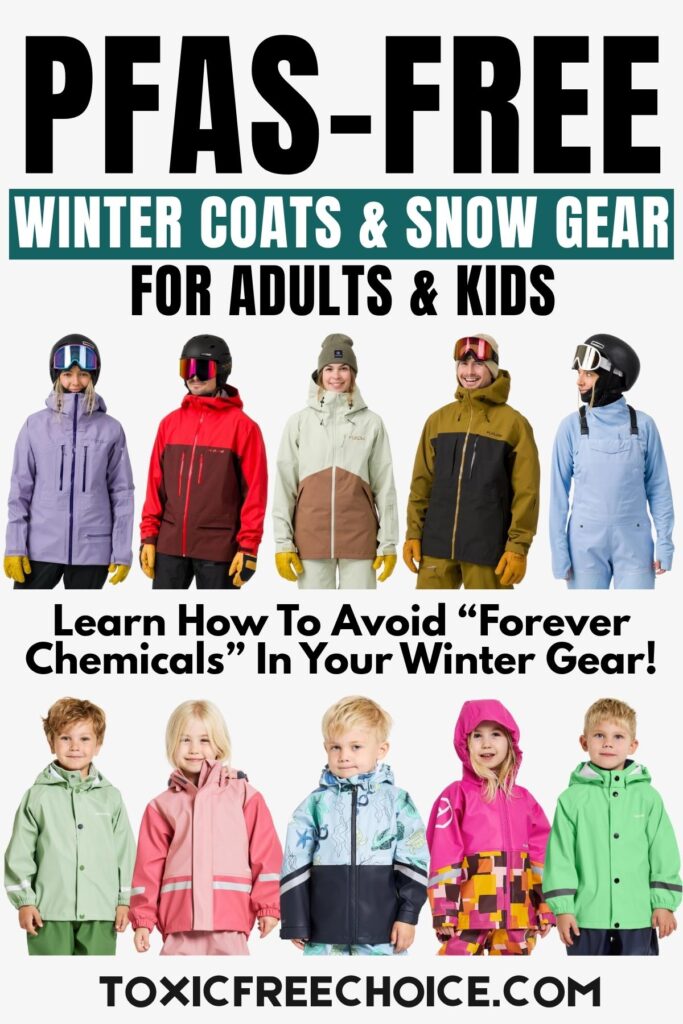
Bundling up for winter shouldn’t mean covering yourself in toxic chemicals.
Yet most winter coats, snow pants, and gloves are still made with PFAS (per- and polyfluoroalkyl substances) despite growing evidence that they are dangerous for our health and destructive to our environment.
PFAS are still used because they are one of the most effective options for making fabrics waterproof, which is essential for staying warm and dry in wet winter weather.
But those carbon-fluorine bonds that make PFAS so great for waterproofing clothing are nearly impossible to break.
This means that PFAS don’t naturally degrade like many chemicals we use and can stick around in the environment or our bodies indefinitely, which is why they are known as “forever chemicals”.
And because they don’t break down, PFAS continue to accumulate over time.
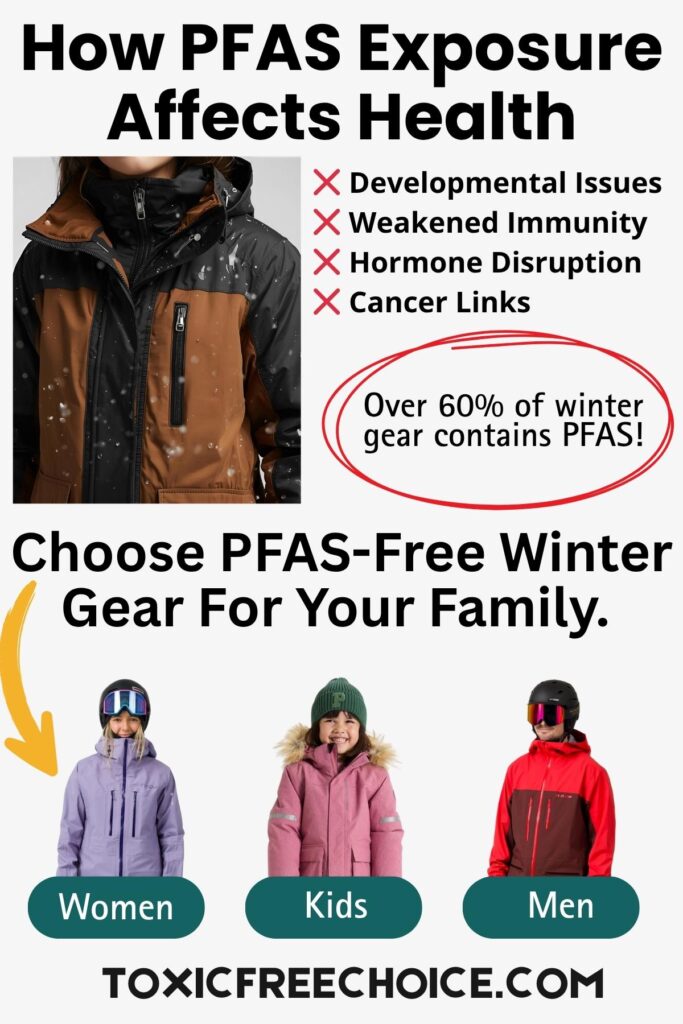
Here’s why it matters: repeated exposure to PFAS over time has been linked to significant health problems, including cancer, hormone disruption, and weakened immunity.
Alongside cookware, winter-weather items like raincoats and workout gear, such as leggings, are major sources of PFAS exposure in our daily lives.
So how can we stay warm and dry without exposing ourselves to these toxic PFAS? Fortunately, safer alternatives exist.
Many companies are returning to centuries-old techniques with a modern twist to create waterproof winter clothing without PFAS.
If you’re concerned about reducing your exposure to PFAS and want to find winter clothing that keeps you warm and dry while avoiding harmful substances, this guide will walk you through the risks, the safe alternatives to waterproof coatings, and brands making PFAS-free winter coats and snow gear.
The Problem With PFAS In Winter Outerwear
What Are PFAS?
PFAS (per- and polyfluoroalkyl substances) are a class of 12,000+ chemical compounds that are used widely across consumer products since they effectively repel water, stains, and grease.
In the 1970s, PFAS were marketed as a breakthrough for outdoor gear.
Brands like Gore-Tex and Polartec incorporated Durable Water Repellent (DWR) coatings in their winter gear, promising fabrics that could remain fully waterproof while staying breathable.
These PFAS-based coatings were marketed as a major innovation in winter wear and quickly became the industry standard.
The Issue: These “forever chemicals” don’t break down and are a lot more toxic than we once thought. Once released, they persist in soil, water, wildlife, and even people.
PFAS have been detected in Arctic snow, global rainwater, and even our tap water.
👉🏼 Concerned about PFAS in your drinking water? Head to our sister site Sustainably Kind Living for our guide to the Best PFAS Water Filter Brands.
How They Spread:
- Manufacturing: Factories discharge PFAS into local water.
- Everyday Wear: Coated fibers shed into household dust.
- Landfills: PFAS leach from landfills or are spread through incineration.
- Outdoor Runoff: When our winter clothing is exposed to rain and snow, it releases PFAS into rivers and alpine ecosystems.
How PFAS Exposure Affects Health
PFAS from waterproof fabrics can transfer to your skin as you wear them.
And as waterproof materials like Gore-Tex age, they start to disintegrate and can become part of dust in your home, where they’re easily inhaled or ingested.
In some cases, volatile particles from newly manufactured waterproof clothing are also released into the air, especially from newly treated outdoor gear.
Beyond the home, every wash cycle or rainy hike can rinse PFAS out of the fabric and into wastewater, where they accumulate in rivers and drinking water supplies.
Documented Health Risks
- Endocrine Disruption: PFAS interfere with hormone function, altering reproductive health and thyroid activity.
- Immune Suppression: Studies show PFAS reduce vaccine response in children.
- Cancer Associations: Kidney and testicular cancers are among the most well-documented risks.
- Developmental & Metabolic Disorders: Exposure is linked to obesity, diabetes, and neurodevelopmental impacts in children.
Children Are Most Vulnerable
- Their skin is more permeable than adults.
- Their surface area-to-body-weight ratio is higher.
- Their organs are still developing.
- They often put their hands and objects in their mouths.
The Short-Chain PFAS Myth
As evidence of the harmful side effects of PFAS grows, some brands have swapped long-chain PFAS for short-chain PFAS marketed as “safer.”
But research shows these alternatives are still highly persistent and carry many of the same health risks — much like how BPS was not a “safer” BPA-free plastic alternative.
The Best PFAS-Free Winter Coats & Snow Gear For Adults
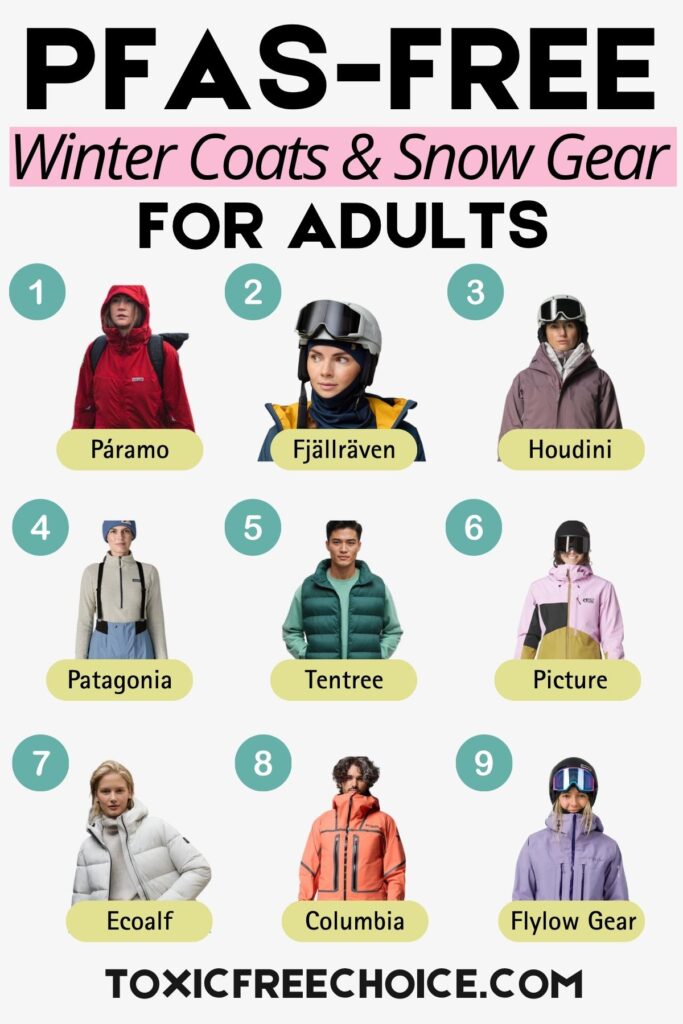
1. Páramo Clothing
Páramo Clothing uses the Nikwax Analogy® system, a PFAS-free fabric that mimics the way animal fur sheds water.
Instead of relying on coatings, the fabric actively pushes moisture away while letting heat escape.
Great for anyone hiking, skiing, or biking in snowy conditions. Beyond the tech, their gear is Fair Trade-made, repairable, and recyclable.
👉🏼 Shop Páramo Clothing
2. Fjällräven
Fjällräven set an early precedent by cutting PFAS from its entire line back in 2015.
Instead of swapping one chemical for another, Fjällräven waterproofs their non-toxic down jackets & insulated coats with its heritage Greenland Wax, a simple paraffin-and-beeswax blend that can be reapplied at home.
Combined with the tightly woven G-1000 fabric, the wax finish holds off wind, snow, and light rain.
👉🏼 Shop Fjällräven
3. Houdini Sportswear
Houdini Sportswear thinks about gear differently. Every jacket and shell is designed to be worn, repaired, and recycled rather than tossed aside.
That mindset helped them drop PFAS across all collections by 2018.
Today, their outerwear uses safer finishes like OrganoTex, made from natural fatty acids, and a recyclable polyester membrane called Atmos.
The goal isn’t just waterproof clothing; it’s clothing that can safely loop back into the system without leaving toxic traces behind.
👉🏼 Shop Houdini Sportswear
4. Patagonia
By 2025, Patagonia will have fully eliminated PFAS from its clothing.
A milestone that matters because the brand sets trends far beyond the outdoor industry.
Instead of the usual fluorocarbon coatings, they’re switching to Gore-Tex’s new ePE membrane, even for their most technical alpine gear.
👉🏼 Shop Patagonia
5. Tentree
Tentree’s winter jackets use recycled polyester with fully taped seams and a fluorine-free C0 DWR 80/10+ finish that sheds 80% of water and lasts through 10+ washes.
As a certified B Corp, Tentree also plants ten trees for every purchase, linking non-toxic outerwear to broader climate action.
👉🏼 Shop Tentree
6. Picture Organic Clothing
This French brand uses recycled polyester with bio-based finishes like Teflon EcoElite, while offering a lifetime repair policy to extend each jacket’s use.
Just as importantly, Picture Organic Clothing prices their PFAS-free gear the same as conventional options, proving the industry claim that “eco” must be more expensive doesn’t have to be true.
👉🏼 Picture Organic Clothing
7. Ecoalf
Ecoalf has built its identity around recycling ocean plastics into high-quality outerwear.
By combining recycled PET with PFC-free water repellent finishes, they showcase how circularity and chemical safety can coexist.
In an industry where green claims often go unchecked, Ecoalf puts its data on the table for everyone to see.
👉🏼 Shop Ecoalf
8. Columbia Sportswear (OutDry™ Extreme Eco Collection)
Columbia Sportswear OutDry™ Extreme Eco collection ditches PFAS entirely, using an exterior membrane that keeps water out without toxic chemistry.
Each jacket repurposes recycled bottles, proving performance gear can reduce waste as well as chemical risk.
The caveat? Only the ECO collection makes this cut, so shoppers need to pay close attention to labels instead of assuming the whole brand is PFAS-free.
👉🏼 Shop Columbia Sportswear
9. Flylow Gear
Flylow Gear leans on Empel, a water-based treatment that bonds directly to fabric and outperforms many conventional repellents without any PFCs.
Their backcountry jackets are built to keep you dry on the steepest ascents and deep powder days.
By pairing this tech with recycled fabrics and thoughtful sourcing, Flylow shows that mountain-ready gear can protect both you and the environment.
👉🏼 Shop Flylow Gear
The Best PFAS-Free Winter Coats & Snow Gear For Kids
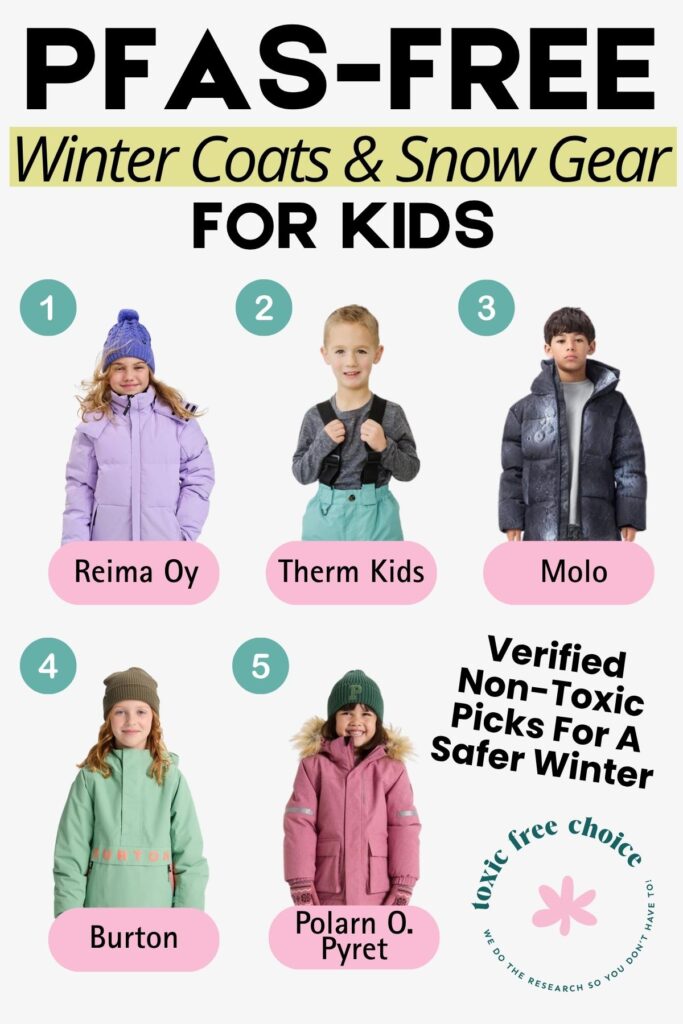
1. Reima Oy
Reima Oy sets the standard for PFAS-free children’s outerwear that actually lasts.
Their durable coats are designed to keep up with all of your kids’ winter adventures.
In 2017, the Finnish brand eliminated PFAS from all of their clothing, replacing standard DWR coatings with BIONIC FINISH® ECO — a fluorine-free water repellent designed to keep cold, wet winter weather out.
👉🏼 Shop Reima Oy
2. Therm Kids
Therm Kids makes PFAS-free kids’ snow and rain gear that keeps safety front and center, without losing any of the fun.
Their playful “SplashMagic” prints reveal hidden patterns when wet, turning gray days into something kids look forward to.
Behind the design is serious safety. Therm avoids PFAS entirely and meets California’s strict Proposition 65 standards, using TPU waterproofing in place of harmful fluorocarbons.
👉🏼 Shop Therm Kids
3. Molo
Bright prints and sharp tailoring make Molo stand out on the playground, but their outerwear is built for serious weather.
Jackets combine recycled fibers with a PFAS-free repellent strong enough to reach a 20,000 mm waterproof rating — a benchmark usually reserved for ski wear.
👉🏼 Shop Molo
4. Burton
Burton has taken PFAS out of its children’s snow gear, replacing old coatings with DRYRIDE C0 finishes that keep kids dry even in heavy, wet snow.
Their PFAS-free snow pants for kids and winter coats are built for all-day play, proving that outerwear can handle slush and storms without toxic chemicals.
For a brand rooted in snowboarding, keeping the wet winter weather out isn’t optional, it’s essential — and Burton shows it can be done without forever chemicals.
👉🏼 Shop Burton
5. Polarn O. Pyret
Swedish brand Polarn O. Pyret has been ahead of the curve in kids’ gear, keeping PFAS out of their winter coats long before it became an industry talking point.
Their focus on safe finishes means little ones stay dry without being wrapped in toxic chemicals.
It’s a reminder that smaller labels often move faster on safety innovations, proving kids’ outerwear can be protective, practical, and low-tox all at once.
👉🏼 Shop Polarn O. Pyret
❌ Greenwashed Winter Gear Brands To Avoid
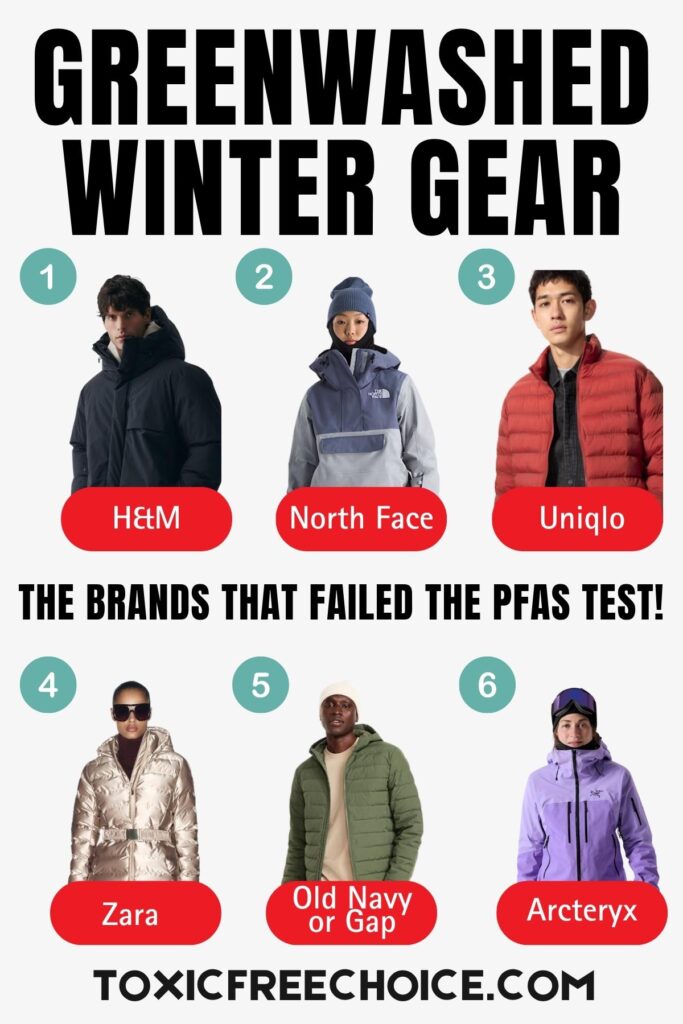
1. H&M
Markets “Conscious” outerwear but still leans on polyester and polyurethane.
While they phased out PFAS in 2013, there’s little proof their current water-repellent finishes are safe.
No bluesign® or OEKO-TEX certifications on their performance outerwear products, so it is likely they are still using fluorinated coatings.
2. North Face
Plans to phase out PFAS in the near future, but most of their jackets still contain PFAS (except some FUTURELIGHT pieces).
Marketing leans on “innovation,” yet certifications usually apply to fabrics, not the full garment.
If shopping with North Face, be sure to verify the product you are purchasing is truly PFAS-free.
3. Uniqlo
Promotes “environmentally friendly” waterproofing, but doesn’t say if they’re fluorine-free (could contain PTFE or PFOAs).
They also don’t have a clear PFAS phase-out plan or third-party certifications for outerwear.
4. Zara
They claim they are no longer selling clothing that contains PFAS, but the proof is thin.
Their “eco-friendly” water-repellent claims lack testing data, and synthetic fabrics (like polyurethane “vegan leather”) are still standard.
5. Old Navy / Gap
Old Navy and Gap like to highlight recycled polyester in their “eco” outerwear lines, but don’t confirm PFAS-free waterproof finishes.
Without transparency into what they are using, their winter weather gear may still use fluorinated coatings.
6. Arcteryx
Emphasizes sustainability, yet much of the line still relies on Gore-Tex, which historically uses PFAS.
A transition to Gore-TEX ePE is underway, but they don’t share a clear plan or timelines.
Until full disclosure, “eco” marketing here is only partial progress.
Tips For Buying Safer Cold-Weather Gear
Labels To Trust
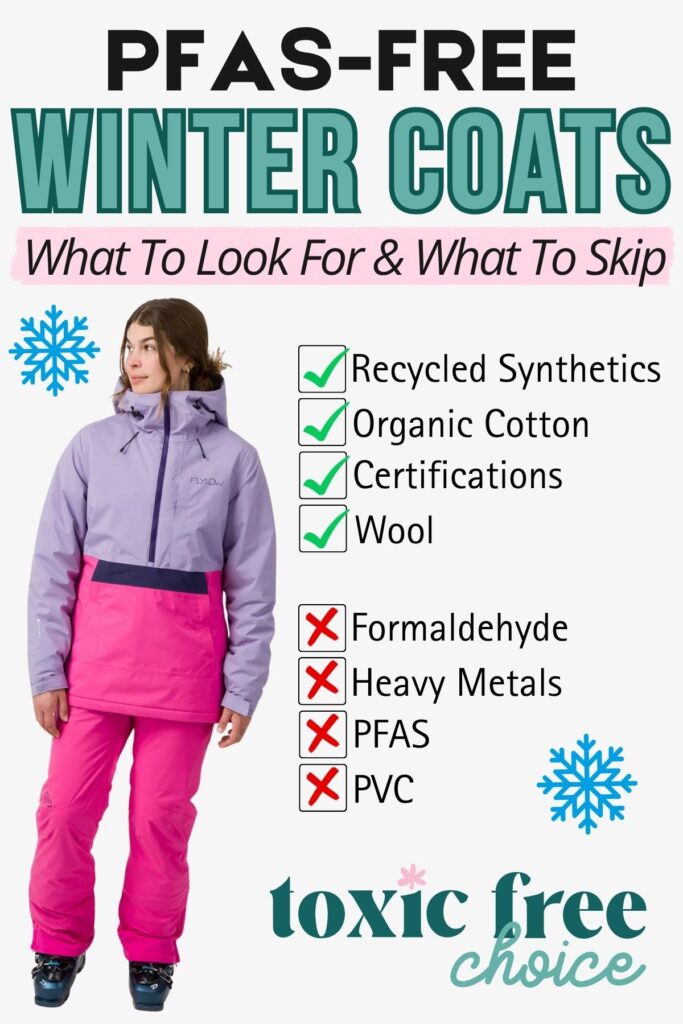
- Look for: “PFAS-free”, “PFC-free”, “fluorocarbon-free”.
- Stay away from DWR coatings.
- Avoid: Vague terms like eco, natural, sustainable, without details on what waterproofing technology they use.
- Reminder: Organic cotton isn’t safe if the finish is PFAS-based
Brand Policies
- Look for clear phase-out dates: “PFAS eliminated in 2020” > “working on safer chemistry”.
- Watch for partial commitments. (e.g., Columbia’s ECO line = PFAS-free; standard OutDry = not).
Red Flags
- “Eco-friendly” claims without details, certifications, or transparent reporting.
- “Waterproof” claims without mentioning the water-repelling technology they do use.
- “PFC-free” only excludes long-chain PFAS (not short-chain).
How To Care For Your PFAS-Free Winter Gear
- PFAS-free finishes need more upkeep.
- Reproof 1–2x per season with a PFAS-free water repellent like NikWax.
- Use a gentle, non-toxic laundry detergent and never use bleach or fabric softeners.
FAQs: PFAS In Winter Coats & Snow Gear
Yes, most conventional winter coats and snow gear still contain PFAS. These chemicals are used to make fabrics water- and stain-resistant, especially in outer shells and linings.
Unless a brand clearly states PFAS-free or uses safer alternatives, it’s likely your coat has them.
PFAS don’t just stay in the fabric — studies show they can rub off on skin or shed into the air and water during use and washing.
While one jacket alone may not cause immediate harm, repeated exposure adds to the “forever chemicals” already building up in our bodies and environment. Choosing PFAS-free gear is a safer long-term option.
Not yet. Patagonia has committed to eliminating PFAS from all water-repellent treatments, with full phase-out targeted for 2025.
Some current jackets are already PFAS-free, but buyers need to check the product details or shop from their “non-fluorinated” collections.
Look for labels like “DWR” (durable water repellent), “Teflon,” or “Gore-Tex” that usually signal PFAS use. If the tag doesn’t specify PFAS-free, assume the coating contains them.
Brands that have switched to safer alternatives typically highlight it clearly in their product descriptions.
No, PFAS don’t wash out like regular chemicals. They’re designed to be permanent, which is why they’re called “forever chemicals.”
Washing a PFAS-treated coat only spreads micro-particles into your laundry water and the wider environment.
Our winter gear should protect us, not put our health at risk!
PFAS were once sold as the only way to stay warm and dry in the winter, but now we know these forever chemicals come at a major cost to our health and the environment.
The encouraging part? Safer alternatives are already available. Brands are proving that warmth, comfort, and performance don’t require PFAS.
Each purchase you make from companies leading this change helps push the outdoor industry toward transparency and the change we need to see safer products on our shelves.
When it comes to safer winter gear, your choice matters for your health, for your family, and for the places we love to explore.
You Might Also Love…
If you’re looking for more PFAS-free products, these guides are a great next step:
- 🌧️ Stay dry without toxins? Check out our guide to PFAS-Free Raincoats & Rain Boots for the whole family.
- 🧶 Cozy up this season with these PFAS-Free Sweaters that keep you warm without forever chemicals.
- 🍰 Love baking? You’ll want to see our list of PFAS-Free Bakeware — safe pans and sheets for every recipe.
- 🥄 Mixing, measuring, and decorating? We’ve vetted the best PFAS-Free Baking Accessories so you can keep toxins out of the kitchen.
- 🛋️ Looking for hygge vibes? Explore our roundup of PFAS-Free Throw Blankets to curl up with on chilly nights.
- 💧 Thirsty for a clean swap? Find out which brands made our list of PFAS-Free Sparkling Water and which to avoid.
Like It? Pin It!
References:
- American Chemical Society. (2025). Research reveals potential alternatives to forever chemicals. https://www.acs.org/pressroom/presspacs/2025/february/research-reveals-potential-alternatives-to-forever-chemicals.html
- Cousins, I. T., DeWitt, J. C., Glüge, J., Goldenman, G., Herzke, D., Lohmann, R., Ng, C. A., Scheringer, M., & Wang, Z. (2021). The high persistence of PFAS is sufficient for their management as a chemical class. Environmental Science: Processes & Impacts, 22(12), 2307–2312. https://doi.org/10.1039/d0em00355g
- Fenton, S. E., Ducatman, A., Boobis, A., DeWitt, J. C., Lau, C., Ng, C., Smith, J.S., Roberts, S. M., … others. (2021). Per- and polyfluoroalkyl substance toxicity and human health review: Current state of knowledge and strategies for informing future research. Environmental Toxicology and Chemistry, 40(3), 606–630. https://doi.org/10.1002/etc.4890
- Frontiers in Water. (2024). Leaching of PFAS from landfills and environmental impact. https://www.frontiersin.org/journals/water/articles/10.3389/frwa.2024.1480241/full
- Nicholas School of the Environment, Duke University. (n.d.). Research published on PFAS in dust. https://sites.nicholas.duke.edu/pfas/research-published-on-pfas-in-dust/
- Phys.org. (2024). Arctic PFAS release in sunny months. https://phys.org/news/2024-12-arctic-pfas-sunny-months.html
- PubMed. (2023). Effects of PFAS on hormone function. https://pubmed.ncbi.nlm.nih.gov/37931739/
- Semiconductor Industry Association. (n.d.). Consortium publishes survey results of PFAS discharges to wastewater. https://www.semiconductors.org/consortium-publishes-survey-results-of-pfas-discharges-to-wastewater/
- Wisconsin Watch. (2023, April). PFAS are in rain jackets, hiking pants, shirts, and other clothing. Here’s what to know. Wisconsin Watch. https://wisconsinwatch.org/2023/04/pfas-are-in-rain-jackets-hiking-pants-shirts-and-other-clothing-heres-what-to-know/